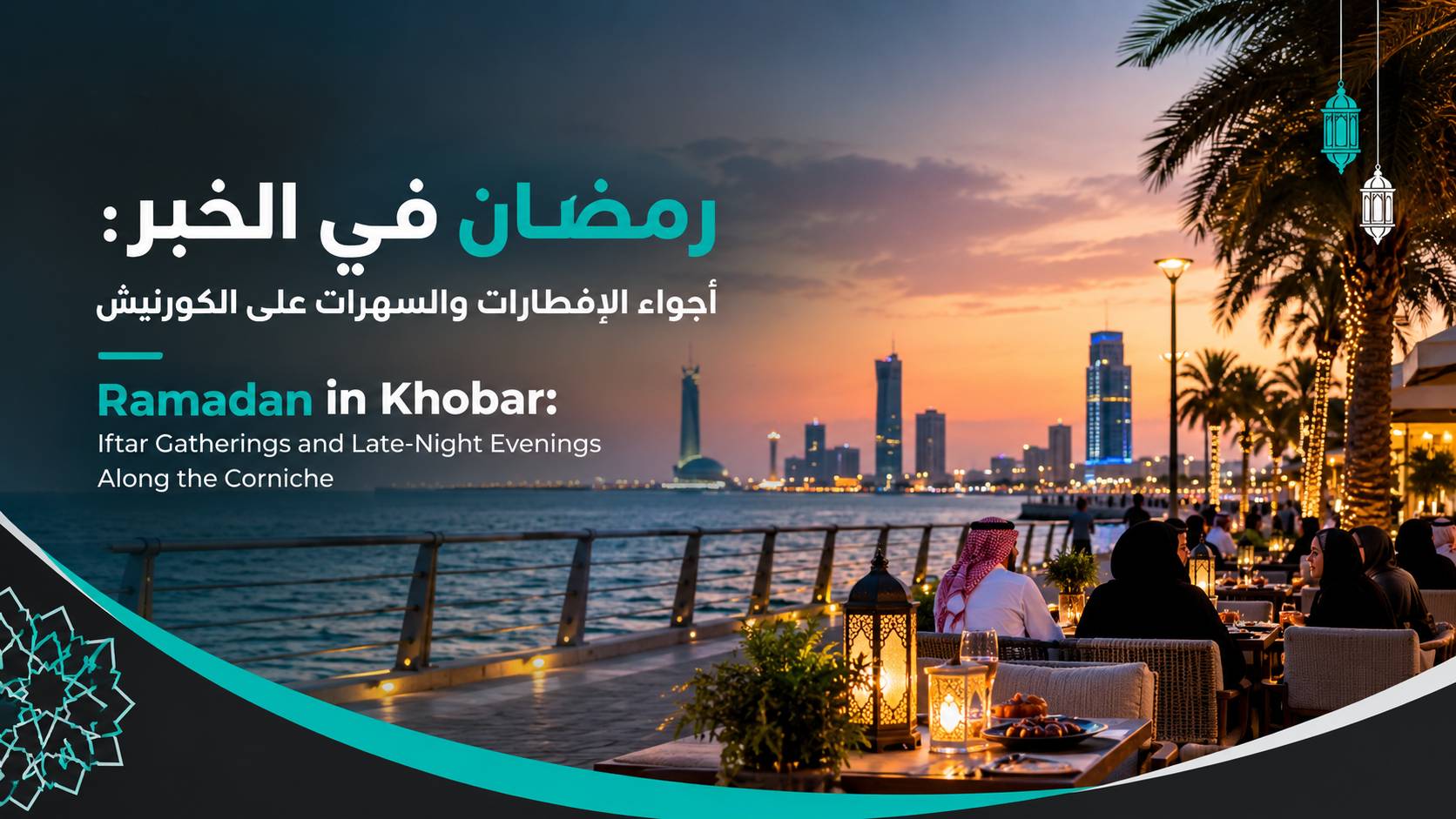

Some cities slow down in Ramadan. Khobar does the opposite. In the hour before Maghrib the streets empty almost completely, and then, roughly thirty minutes after the call to prayer, the city reappears along the water in a way you will not see during any other month of the year. This guide from Dyafa (dyafa.com) explains Ramadan in Khobar as residents and returning visitors actually live it, from the pre-iftar rush to suhoor just before dawn.
Whether you are travelling from Riyadh, crossing the King Fahd Causeway from Bahrain, or already living in the Eastern Province and looking for a better way to spend your evenings, you will find a complete map here: the types of iftar available, the rhythm of the night, the best hours to be on the Khobar Corniche, and exactly where to stay so the evening does not end in a long drive home.
Ramadan in Khobar revolves around three moments: iftar at a hotel buffet, a sea-facing restaurant or a traditional Ramadan tent; then Taraweeh prayers; then a long evening along the Khobar Corniche and Prince Turki Street that runs until suhoor.
Where to stay: waterfront and Corniche hotels if you want to walk to the evening, serviced apartments for larger families, and Dhahran or Dammam as a quieter, lower-priced alternative with a short drive.
Ramadan moves about eleven days earlier every year, so daylight hours, weather and fasting length all shift from one year to the next. Restaurant hours, buffet pricing and hotel rates change too. Use this guide as a stable planning framework, and confirm opening times and reservations directly before you travel.
Khobar is a coastal city, and most of its social life already orbits the sea. In Ramadan that geography becomes a real advantage. The evening breeze off the Gulf makes outdoor seating comfortable for hours, while more inland cities depend almost entirely on enclosed, air-conditioned majlis spaces.
The population adds the second layer. Khobar is culturally mixed by nature, shaped by the business hubs of Dhahran and Jubail and closely tied to Bahrain and the wider Gulf through the King Fahd Causeway. The result is a Ramadan scene where a traditional Saudi table, a Gulf kitchen and an international restaurant can sit on the same street.
In the current years, Ramadan falls during winter and early spring, which is the best climate window on the Eastern coast. That means evenings on the Khobar Corniche are mild and genuinely comfortable for families and children, and outdoor seating at cafés and restaurants operates at full capacity. As the years pass the month will gradually shift into hotter periods, which makes this particular stretch one of the best times to experience Ramadan in Khobar outdoors.
Khobar becomes a fully nocturnal city during Ramadan. Real activity begins after Maghrib, peaks between 10 p.m. and midnight, and continues in cafés and suhoor spots until shortly before Fajr. Mornings, in contrast, are unusually quiet. If you are planning any daytime activity, build your schedule around that reversal rather than fighting it.
The final hour before the call to prayer is the calmest moment in the city and, at the same time, the heaviest on the roads. If you are eating out, arrive at your venue at least forty minutes before Maghrib. Traffic on the routes leading to the waterfront builds sharply in the last half hour, and arriving ten minutes before the adhan is a bet most visitors lose.
Tables in Khobar usually open with dates, Arabic coffee and water, followed by soup and samosas, then the main dishes. Eastern Province tables are known for harees, jareesh, and rice dishes with lamb or local fish, finished with Ramadan sweets such as luqaimat and muhalabia. Corniche restaurants and hotel buffets bring all of that together alongside Gulf, Levantine and international options.
This is the real picture of Ramadan in Khobar. Once Taraweeh ends, the Corniche walkway fills with families, cafés open their outdoor seating, and sea-facing tables become almost impossible to get without a reservation. Children use the play areas, groups of friends spread across the cafés, and Prince Turki Street and the malls stay busy well past midnight.
Suhoor in Khobar is a social occasion in its own right, running from around midnight until shortly before the dawn prayer. Cafés and restaurants serve foul, shakshuka, pastries and tea, and several of them look directly onto the water. If you want the Corniche at its calmest and most pleasant, try sitting there at around two in the morning.
In Khobar, Ramadan does not start at iftar and end after Taraweeh. The night is the longest part of the day, and the Corniche is where the city chooses to spend it.
The most popular choice for visitors and large groups. Khobar hotels run wide iftar buffets combining Saudi, Gulf and international dishes, usually with both indoor and outdoor seating. The advantages are variety and family suitability; the drawbacks are higher prices and the need for an advance reservation, particularly on weekends and during the last ten nights.
These give you iftar with a direct view over the Gulf, which is the single most requested experience in Khobar during Ramadan. Outdoor waterfront tables are booked days ahead, not hours. When you reserve, ask specifically for an outdoor or view table rather than accepting a general booking and hoping for the best.
Ramadan tents operate at hotels and some open venues, offering a traditional setting with floor seating, Arabic coffee and tea, and sometimes accompanying programmes. They suit anyone looking for atmosphere rather than just a meal, and they work particularly well for long family gatherings and post-Taraweeh meetups with friends.
A long-standing Khobar tradition: the meal is prepared at home and eaten on the green spaces along the Corniche. It is the most affordable option and often the most enjoyable for families, but it requires arriving early to secure a good spot, and leaving the area clean afterwards.
Local eateries and quick-service restaurants across Khobar offer reasonably priced iftar, and many visitors prefer them so they can spend more on the evening itself. Order ahead or arrive early, because pressure on these places in the thirty minutes before Maghrib is intense.
| Experience | Best For | Atmosphere | Price Level |
|---|---|---|---|
| Hotel buffet | Families, groups, visitors | Organised and varied | High |
| Sea-facing restaurant | Occasions and small groups | Best views | Moderate to high |
| Ramadan tent | Traditional atmosphere seekers | Traditional and unhurried | Moderate to high |
| Family iftar on the Corniche | Families with children | Open-air and communal | Lowest cost |
| Casual eateries | Individuals and tight budgets | Fast and crowded | Budget-friendly |
If your trip covers a weekend or the last ten nights, book the hotel and the iftar together at least two weeks ahead. Sea-view tables and Corniche-facing rooms are the first things to disappear in Khobar during Ramadan, and no budget brings them back once they are gone.
Arrive well before Maghrib and stay in a hotel or apartment near the Corniche so you are not driving late at night. A reliable plan: iftar inside the hotel on the first evening to avoid the rush, a sea-view restaurant on the second, and Corniche evenings after Taraweeh on both nights.
Travellers using the King Fahd Causeway arrive straight into Khobar. What matters most is avoiding peak crossing times just before Maghrib and on weekend nights, and choosing a hotel near the causeway exit or the Corniche with guaranteed parking.
Many people who already live in the region book one or two nights in Khobar during Ramadan simply to enjoy the evening without the late drive home. This kind of short local stay is a smart move on weekends and costs far less than a full trip outside the province.
The priority here is cafés, late evenings and suhoor, which makes central Khobar or the Prince Turki Street area the right base. A two or three bedroom serviced apartment usually costs considerably less than several separate hotel rooms.
If you work in Dhahran or Jubail and remain in the region for the month, you need a hotel that balances daytime proximity to the office with easy access to the Corniche at night. Northern Khobar and Dhahran both handle that combination well.
| Time | Activity | Practical Note |
|---|---|---|
| One hour before Maghrib | Travel to your iftar venue | Heaviest traffic on Corniche routes |
| Maghrib | Iftar | Reservations essential at buffets |
| After Isha | Taraweeh prayers | Nearby mosques fill early |
| 10 p.m. to midnight | Peak Corniche evening | Parking fills; walk from your hotel |
| After midnight | Cafés, shopping, quieter sitting | Best hours for space and calm |
| Before Fajr | Suhoor | Check closing times in advance |
The first choice for anyone who wants to experience Ramadan in Khobar without driving. You step out of the lobby and into the evening, which solves the month's two biggest frustrations at once: traffic and parking. Sea-view rooms are the most requested category, so book them well in advance.
Closer to restaurants, cafés and shopping, and usually priced below the waterfront properties. A good fit for groups of friends and for anyone who cares more about the evening and the shopping than about the view from the room.
The best option for large families and longer stays. Having a kitchen genuinely matters in Ramadan: it lets you prepare suhoor or a simple iftar without going out every night, and it lowers total cost noticeably compared with booking two or three hotel rooms.
If Khobar rates are high for your dates, Dhahran and Dammam offer lower prices with a ten to fifteen minute drive outside peak hours. The trade-off is losing the ability to walk home after the evening, so weigh the saving against the convenience honestly.
First, planning to arrive ten minutes before the adhan on Corniche routes. Second, booking a hotel "in Khobar" without checking the district or its real distance from the waterfront. Third, assuming restaurants operate normally during the day, when most open only shortly before Maghrib. Fourth, delaying bookings for the last ten nights, which are the highest-pressure dates of the entire month.
At dyafa.com the booking experience is built around the question that actually matters: which affordable stay is closest to where I will spend my evening? So the platform prioritises side-by-side comparison of hotels and serviced apartments, transparent display of inclusions and fees before you confirm, filtering by location, property type and group size, and Arabic and English guidance that explains the destination and its atmosphere before you arrive.
If you are staying several nights, it is worth stepping outside the Corniche routine. The Eastern Province offers distinct Ramadan atmospheres within short distances:
On the first day of Eid the city shifts again: Eid prayers at the large prayer grounds, family visits, and then unprecedented crowds on the Corniche, in the malls and at restaurants. If you plan to spend Eid in Khobar, understand that these are the highest-demand dates for hotels anywhere in the Eastern Province, and booking weeks ahead is a necessity rather than a preference.
Ramadan has shifted in recent years from a purely local season into a domestic tourism season in its own right, which aligns directly with the goals of Saudi Vision 2030 around growing domestic tourism and improving quality of life in Saudi cities. Khobar is among the biggest beneficiaries of that shift, thanks to its coastal setting and its proximity to the Gulf market.
Three trends look likely to continue: more organised Ramadan programming in the form of night markets, activations and family events; growing hotel capacity and a wider range of short-term accommodation; and a better digital booking experience that makes comparison faster and pricing more transparent.
For the traveller the implication is clear. Choice keeps expanding, but competition for the best-located rooms and tables grows with it, and early planning remains the strongest advantage you can hold.
The Khobar Corniche and waterfront are the first choice by a wide margin, especially after Taraweeh. Prince Turki Street follows with its cafés and restaurants, and the large malls stay open late throughout the month.
Yes, particularly on weekends and during the last ten nights. Hotel buffets and sea-facing restaurants are booked days ahead, and it is worth confirming the table type and location when you reserve rather than assuming.
For atmosphere and energy, between 10 p.m. and midnight is the peak. For space and quiet, go after midnight and before suhoor, when the crowds thin out but the setting stays pleasant.
Yes, and it is one of the most family-suited cities in the Kingdom for this month. The Corniche provides a walkway, open spaces and play areas, most restaurants and cafés have family sections, and the evening environment remains safe and orderly until late.
Rates vary by hotel category, distance from the Corniche and how early you book, and they rise clearly on weekends and during the last ten nights. The only accurate way to know is to compare live prices for your exact dates on a platform such as Dyafa, since any fixed figure quoted in an article becomes outdated quickly.
Most restaurants begin service shortly before Maghrib and continue until suhoor. Some hotels make arrangements for non-fasting guests, so ask at the time of booking if that matters for your trip.
Suhoor cafés and restaurants are concentrated around the Corniche and central Khobar, and several offer direct sea views. Check closing times beforehand, since hours differ between venues and often change during the last ten nights.
Several weeks before the month begins, choosing a rate with free cancellation. Prices climb as the dates approach, especially once the last ten nights and the Eid holiday come into view, and late booking rarely works in your favour.
Ramadan in Khobar combines spirituality, social life and the sea in a single evening. An iftar table looking out over the Gulf, then Taraweeh, then a long family evening on the Corniche that runs until suhoor. That combination is exactly why the city has become a favourite Ramadan destination for Eastern Province residents and for visitors from Riyadh and across the Gulf.
The practical summary is simple. Choose your stay by its distance from the Corniche rather than by the city name on the listing. Reserve both your iftar and your room early, especially for weekends and the last ten nights. And plan your evening instead of leaving it to chance. Do that, and the trip turns from a crowded night into a Ramadan memory worth repeating.
Compare hotels and serviced apartments across Khobar, Dhahran and Dammam, see prices and inclusions side by side, and reserve the closest option to the Corniche before the best locations are gone.
Ramadan in Khobar, Khobar Corniche, iftar in Khobar, suhoor in Khobar, Ramadan tents Khobar, Khobar hotels Ramadan, serviced apartments Khobar, Eastern Province Ramadan, King Fahd Causeway, sea view restaurants Khobar, best iftar buffets in Khobar, where to stay near Khobar Corniche during Ramadan, what to do after Taraweeh in Khobar, best time to visit Khobar Corniche in Ramadan, how much do hotels cost in Khobar during Ramadan, family-friendly Ramadan activities in Khobar, Eid in Khobar, Saudi Vision 2030 tourism, Dyafa




© Copyright 2024 Dyafa - All Rights Reserved | Created By Fandaqah Information Technology