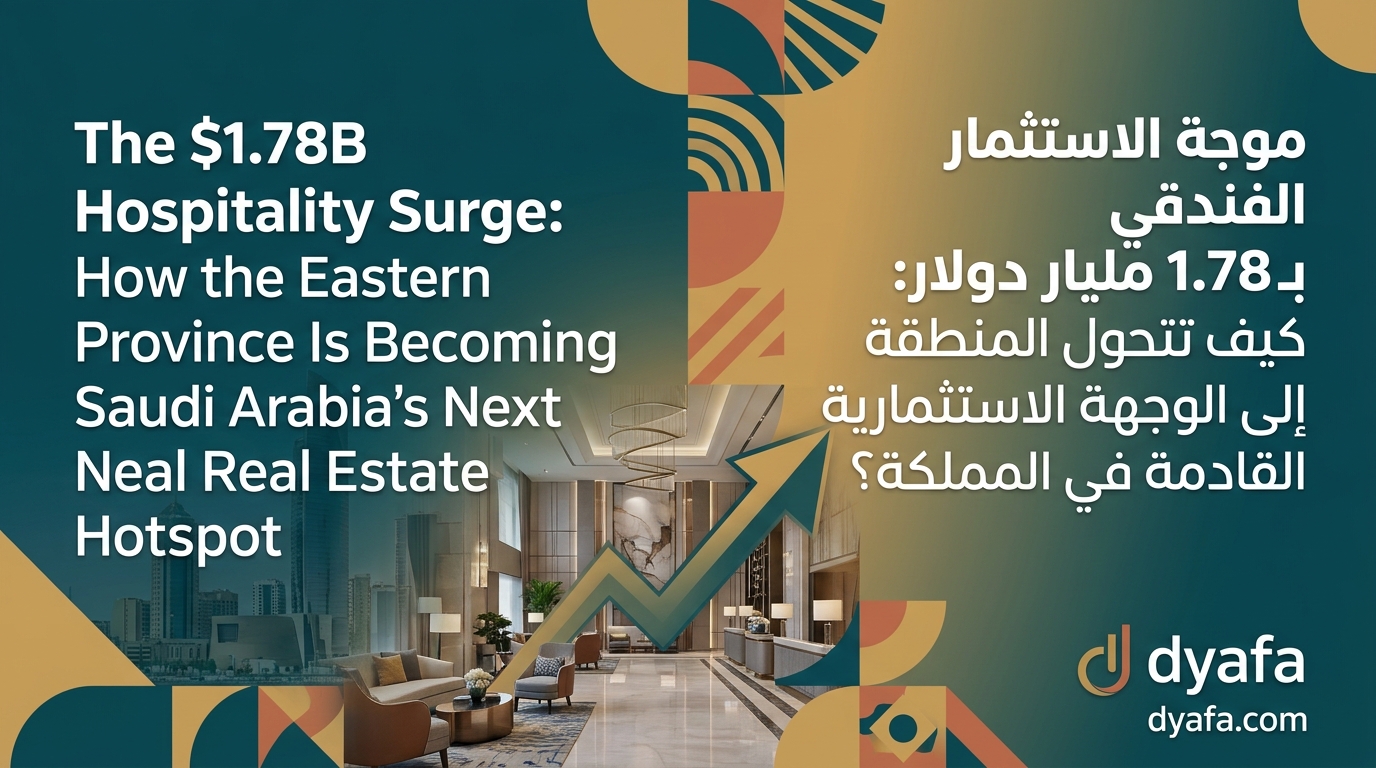

Discover how a $1.78B hospitality surge is transforming Saudi Arabia’s Eastern Province into an institutional real estate powerhouse driven by Vision 2030.
Historically recognized as the industrial heart of the Kingdom of Saudi Arabia, the Eastern Province—anchored by Dammam, Al Khobar, and Dhahran—is executing a profound economic pivot. While the global energy sector anchored by Saudi Aramco has long defined the region's capital flows, a new wave of asset allocation is reshaping its physical skyline: commercial real estate and hospitality.
Backed by deliberate state-led initiatives under Vision 2030 and significant capital deployment from the Tourism Development Fund (TDF), the Eastern Province has unlocked an estimated $1.78 billion hospitality and entertainment development pipeline. This investment influx is shifting the region from a purely commercial transit hub into a lifestyle, cultural, and business destination.
For real estate developers, private equity funds, and institutional operators, the Eastern Province offers a rare market dynamic: high domestic purchasing power, steady corporate demand, cross-border GCC connectivity, and historically undersupplied prime lifestyle hospitality assets.
Beyond Hydrocarbons: The Catalysts Behind the Eastern Province’s Hospitality Boom
The Eastern Province’s commercial repositioning is not accidental; it is the structural result of supply-side interventions and massive demand catalysts.
For decades, the hospitality sector in the Dammam Metropolitan Area (DMA) served transient energy professionals. The inventory consisted largely of midscale corporate hotels, serviced apartments with fragmented operational standards, and standard business lodging. Today, three structural forces are driving a permanent reallocation of capital:
* Macroeconomic Diversification Initiatives: The Kingdom's National Tourism Strategy aims to attract 150 million annual visitors by 2030, contributing 10% to national GDP. The Eastern Province is targeted not merely as a corporate corridor, but as an experiential coastal gateway.
* The Tourism Development Fund (TDF) Enablement: With over $4 billion in capital deployed nationwide via direct equity, debt facilities, and guarantees, the TDF has actively partnered with institutional developers to de-risk high-value mixed-use projects across Al Khobar, Dammam, and Al Ahsa.
* Cross-Border Regional Demand: The King Fahd Causeway remains one of the busiest land borders in the Middle East, channeling millions of regional visitors from Bahrain and the broader GCC directly into the Eastern Province annually.
* Industrial Mega-Projects: Initiatives like the King Salman Energy Park (SPARK) and maritime expansions at Ras Al Khair are introducing thousands of specialized expatriate executives, driving institutional demand for extended-stay and upscale hospitality brands.
Key Drivers of the Eastern Province Real Estate Transformation:
├── Cross-Border Mobility (King Fahd Causeway & Regional GCC Traffic)
├── Public Capital De-risking (Tourism Development Fund & PIF Programs)
├── Corporate Modernization (SPARK, Aramco Supply Chains, Logistics)
└── Lifestyle Supply Deficit (Shift from standard corporate rooms to branded lifestyle assets)
Strategic Urban Clusters: Dammam, Al Khobar, and Al Ahsa
The Eastern Province is not a monolithic real estate market. The $1.78 billion capital deployment is concentrating across distinct micro-markets, each presenting a distinct risk-yield profile.
+----------------+-------------------------------+-----------------------------------+
| Micro-Market | Primary Target Demographic | Dominant Asset Class Focus |
+----------------+-------------------------------+-----------------------------------+
| Al Khobar | GCC Tourists, High-Net-Worths | Ultra-luxury, Lifestyle, Corniche |
| Dammam | Commercial, Business, Events | Upper-midscale Business, MICE |
| Al Ahsa | Cultural & Eco-Tourists | Heritage Boutique, Wellness |
+----------------+-------------------------------+-----------------------------------+
Al Khobar: The Lifestyle and Luxury Capital
Al Khobar commands the highest average daily rates (ADR) and revenue per available room (RevPAR) in the province. The city’s waterfront—the Al Khobar Corniche—has transformed into prime real estate for luxury lifestyle developments, mixed-use commercial projects, and high-end branded residences.
International operators that historically concentrated on Riyadh and Jeddah are securing flags along Khobar’s coastline. The city directly targets high-net-worth domestic travelers and GCC weekenders seeking upscale culinary, leisure, and wellness offerings within driving distance.
Dammam: The Commercial Backbone and MICE Anchor
Dammam functions as the administrative and logistics center. The development pipeline here targets the corporate traveler, Meetings, Incentives, Conferences, and Exhibitions (MICE) facilities, and upper-midscale accommodations.
Dammam's hospitality real estate is closely linked to infrastructure expansion, including the King Fahd International Airport master plan and industrial logistics parks. The opportunity here lies in standardized, institutionally managed select-service and corporate hotels that replace outdated, independent inventory.
Al Ahsa: Heritage, Agri-Tourism, and Cultural Assets
A UNESCO World Heritage site and home to the world's largest self-contained oasis, Al Ahsa represents the boutique and heritage investment frontier.
Rather than high-density urban developments, institutional capital is flowing into luxury eco-resorts, wellness sanctuaries, and heritage conversions. This submarket capitalizes on domestic and international demand for regenerative and culture-focused travel, diversifying the province’s overall hospitality portfolio.
Changing Search Patterns and Traveler Demographics: The "Hotel Near Me" Paradigm
The evolution of traveler demographics in the Eastern Province has dramatically reshaped how assets capture market share. Ten years ago, corporate procurement departments booked hotel inventory via long-term negotiated corporate contracts with fixed room blocks. Today's commercial performance depends on high-velocity consumer discovery and flexible business-leisure ("bleisure") travel.
When a regional executive lands at King Fahd International Airport or a GCC family crosses the Causeway on a Thursday afternoon, demand capture happens instantly on mobile devices. The search intent behind queries like **hotel near me** is no longer just about geographic proximity; it serves as a digital proxy for immediate availability, localized amenities, experiential dining, and high-quality ratings.
Consumer Search Evolution in the Eastern Province:
Past Booking Channels:
[Corporate Procurement Contracts] ──> [Rigid Room Allocations] ──> [Traditional Business Hotels]
Modern Search Architecture:
[Algorithmic Mobile Discovery ("hotel near me")] ──> [Real-Time Proximity & Reviews] ──> [Integrated Lifestyle / Mixed-Use Assets]
To secure yields, asset managers must design and operate assets that win in this hyper-localized search environment:
* Integrated Urban Positioning: Properties must offer frictionless access to lifestyle amenities. A property optimized for local discovery requires immediate integration with high-end food and beverage (F&B) venues, co-working infrastructure, and retail spaces.
* Algorithmic Visibility and Local Real Estate Optimization: Mixed-use assets that rank organically for proximate searches do so because their digital footprint matches real-world utility. Modern institutional properties feature distinct public venues (specialty coffee shops, destination spas, private business lounges) that drive continuous local foot traffic, boosting digital relevance and keeping occupancy rates resilient across both weekdays and weekends.
* Flex-Stay Architecture: Modern assets combine long-term corporate serviced apartments with short-stay hotel rooms, allowing operators to dynamically adjust their inventory based on real-time corporate and leisure booking surges.
Real Estate Synergies: Mixed-Use Developments and Branded Residences
Standalone hotels are increasingly rare in new Eastern Province feasibility models. Developers are favoring integrated, mixed-use ecosystems that distribute development risk, optimize floor area ratios (FAR), and maximize return on invested capital (ROIC).
┌───────────────────────────────────────┐
│ Modern Hospitality-Anchored Ecosystem │
└──────────────────┬────────────────────┘
│
┌─────────────────────┼─────────────────────┐
▼ ▼ ▼
┌──────────────┐ ┌──────────────┐ ┌──────────────┐
│ Branded │ │ Curated │ │ Grade-A Flex │
│ Residences │ │ F&B/Retail │ │ Workspaces │
└──────────────┘ └──────────────┘ └──────────────┘
Branded Residential Premiums
Branded residences—developments combining hotel management and amenities with privately owned residential units—are commanding notable premiums in Al Khobar. Investors and affluent local buyers are paying premiums between 25% and 40% over non-branded luxury residential inventory.
For the developer, this model accelerates upfront cash flows through off-plan sales, significantly de-risking the project's construction debt while providing the hospitality operator with built-in baseline revenue.
Hospitality as a Retail and Commercial Anchor
Historically, retail was anchored by hypermarkets or department stores. In modern Eastern Province developments, lifestyle hospitality acts as the primary foot-traffic generator.
High-end boutique hotels activate ground-floor retail, curated food halls, and Grade-A flexible workspace environments. This synergy creates higher commercial yields across the entire square meterage of the master plan, insulating the asset from the retail contraction seen in secondary and tertiary markets.
Investment Challenges and Strategic Playbooks for Developers
While the headline figure of $1.78 billion demonstrates strong momentum, deploying institutional capital into the Eastern Province requires navigating specific local and sector-wide risks.
* **Pipeline Compression and Oversupply Risks:** With multiple luxury properties breaking ground simultaneously along the Al Khobar Corniche, the upper-upscale segment could face short-term ADR compression if delivery timelines converge between 2026 and 2028.
* **Rising Construction and Financing Costs:** Global supply chain constraints, combined with elevated local demand for building materials driven by Riyadh's and NEOM's gigaprojects, have driven up development costs. Developers must maintain disciplined underwriting and contingency allowances.
* **Talent Acquisition and Saudization Mandates:** Attracting, training, and retaining skilled operational talent while meeting national Saudization targets remains a critical operational priority. Operators must invest in long-term human capital programs rather than relying on short-term recruitment fixes.
To navigate these headwinds, leading institutional sponsors are executing specific strategies:
1. **Forming Joint Ventures with State Funds:** Partnering directly with the Tourism Development Fund (TDF) or regional investment vehicles provides low-cost capital access and streamlines zoning, permitting, and regulatory approvals.
2. **Focusing on Underserved Mid-Market Niches:** While luxury projects attract attention, high-quality, tech-enabled 3- and 4-star properties targeting the young Saudi professional and domestic corporate traveler offer some of the highest cash-on-cash yields.
3. **Prioritizing Sustainable Construction (ESG):** Aligning asset development with the Saudi Green Initiative and securing LEED or Mostadam green building certifications opens access to international green financing and lower debt margins.
---
## The Long-Term Horizon: Positioning for Sustainable Yields by 2030
The transformation of the Eastern Province’s real estate landscape marks an evolutionary shift from a single-industry corporate hub to a diversified, high-yield commercial property market.
Eastern Province Real Estate Trajectory:
[1980–2010: Monolithic Oil/Gas Accommodations]
│
▼
[2015–2023: Early Commercial & Infrastructure Modernization]
│
▼
[2024–2030+: Integrated Lifestyle, Culture & Institutional Hospitality Infrastructure]
The success of the $1.78 billion pipeline will not be measured purely by key additions, but by the financial performance, operational longevity, and asset flexibility of the properties delivered. As infrastructure links improve—including planned GCC rail modernizations and airport expansions—the Dammam Metropolitan Area and Al Ahsa will capture an increasing share of regional travel budgets.
For institutional investors, developers, and global brands, the window of early-entry advantage is closing. The Eastern Province is moving toward operational maturity, and those deploying capital with clear product differentiation, mixed-use synergy, and localized operational focus are well-positioned to achieve reliable, long-term returns in the Kingdom’s industrial and lifestyle engine.
Are you evaluating development opportunities, joint ventures, or asset acquisitions in Saudi Arabia's rapidly evolving commercial real estate sector? Partner with market-leading advisory professionals to conduct localized feasibility studies, structure TDF-backed capital stacks, and unlock sustainable portfolio yields across the Kingdom.



© Copyright 2024 Dyafa - All Rights Reserved | Created By Fandaqah Information Technology