
Quick Answer
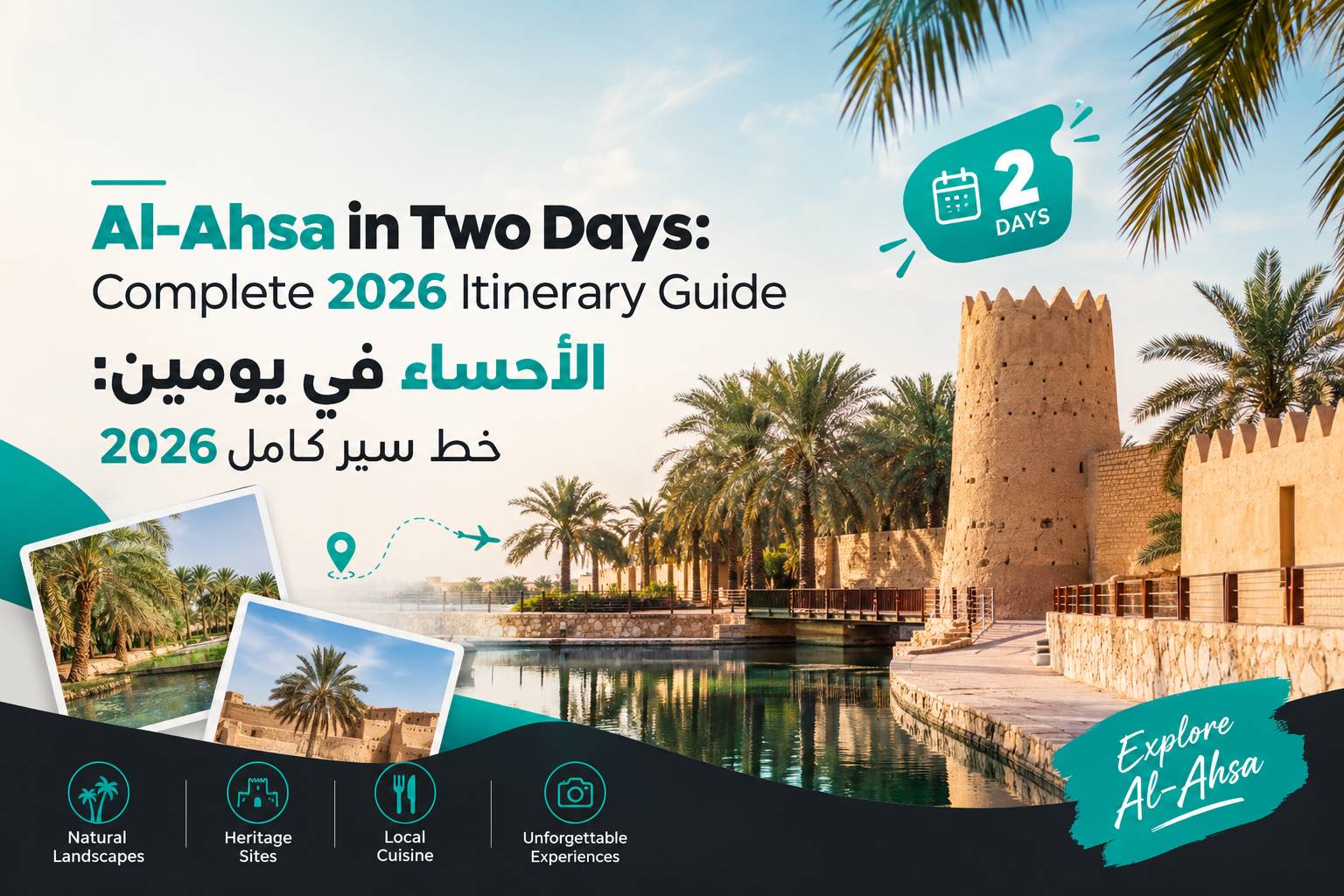
You can cover Al-Ahsa's major landmarks in two full days using this order: Day 1 is heritage — Ibrahim Palace in Al-Kut district, Al-Qaisariya Souq in Al-Rifa'ah, Al-Ahsa Museum, then sunset inside the palm oasis. Day 2 is nature — Al-Qarah Mountain with its caves that stay cool in summer and warm in winter, the Land of Civilizations Museum, Jawatha Mosque and Park, Ain Najm spring, and finally Al-Asfar (Yellow) Lake or the historic Uqair Port. Al-Ahsa Oasis has been on the UNESCO World Heritage List since 2018 and is the largest palm oasis surrounded by sand in the world, with more than 3 million palm trees.
Al-Ahsa is not a destination you tick off in an afternoon. It is a living oasis and one of the most historically dense places in the Arabian Peninsula — the largest palm oasis surrounded by sand anywhere in the world, added to the UNESCO World Heritage List in 2018 for clear reasons: castles and mosques going back centuries, a heritage market described as among the oldest in the Gulf, a genuinely unusual geological formation, and an irrigation system fed by natural springs that has supported agriculture for thousands of years.
Most visitors make one of two mistakes. Some give it a single day and leave with a shallow impression of "a mountain and a market." Others block out four days and discover that half their time went into driving and waiting. Two days is the practical sweet spot: long enough to see the major sites properly, short enough to fit a weekend from Dammam or Riyadh.
This guide gives you a complete two-day Al-Ahsa itinerary with realistic timings, actual distances, and honest notes about where each site disappoints — because a travel guide that praises everything is useless for planning. If you are searching for things to do in Al-Ahsa in two days, this is the plan you can follow hour by hour.
| Detail | Information |
|---|---|
| Location | Eastern Province; main city is Hofuf |
| UNESCO status | World Heritage Site, inscribed 2018 |
| Palm trees | More than 3 million productive trees |
| Distance from Dammam | About 150 km / 1.5 hours by car |
| Distance from Riyadh | About 330 km / 3.5 hours by car |
| How to arrive | Al-Ahsa International Airport, train to Hofuf, or road |
| Best season | October to March |
| Ideal duration | 2 days for main sites; 3 days including Uqair and Al-Taraf |
Tip Box: A Car Is Not Optional
Al-Ahsa's landmarks are spread across a very large area — between Hofuf, Al-Mubarraz, Al-Qarah, Al-Oyun, and Al-Taraf. Ride-hailing apps exist but are impractical for a dense multi-stop itinerary. If you arrive by train or plane, renting a car is the single most important decision of the trip. Skip it and you will spend your budget on fares and your patience on waiting.
Ibrahim Palace sits in the northern part of Al-Kut, one of the oldest districts in Al-Ahsa, and once formed part of the city's northern wall. It covers roughly 16,500 square metres. Its original construction dates back to the Jabrid era, before the Ottomans arrived; the Ottomans took the palace during their first campaign and built the Al-Kut wall around it.
This is more than an old building. It holds a pivotal moment in Saudi history: King Abdulaziz bin Abdulrahman seized the palace along with its soldiers and equipment on the first day he recovered Al-Ahsa, on the night of Monday 28/5/1331 AH. Standing inside its walls, you are looking at the physical dividing line between two eras of the region's history.
Duration: 1 to 1.5 hours. Weak point: Shade is limited in the open courtyards. A morning visit is not a preference here — it is a requirement for most of the year.
A few minutes from Ibrahim Palace, in the Al-Rifa'ah district of Hofuf, stands Al-Qaisariya Souq. The market contains around 422 shops whose architecture echoes the traditional building style of the Eastern Province: narrow enclosed roofed passages, deliberately built high to allow natural ventilation and daylight.
That architectural detail is exactly what makes walking through Al-Qaisariya an experience rather than a shopping errand — you are moving through a centuries-old passive cooling system. The souq is known for bishts and abayas, fabrics, spices, dates, and handicrafts, and it holds a special place in local life during Ramadan, when its passages fill with visitors, including many who come purely for the atmosphere rather than to buy anything.
The real value of Al-Qaisariya Souq is not what is on the shelves. It is that the souq still functions as a souq. This is not a reconstructed museum set built for visitors — it is a market where people from Al-Ahsa actually shop. The difference between those two things is the difference between living heritage and decoration.
Duration: 1 to 2 hours. What to buy: Local dates, especially Khalas, are the best thing to carry home. Ask about the harvest year and grade, and expect prices to be negotiable in most shops.
Al-Ahsa Museum presents a structured account of the region from the Stone Age to the modern era, passing through the Dilmun and Gerrha civilizations. Its most useful feature in a tight itinerary is practical rather than academic: it is fully air-conditioned, which makes it the ideal place to be during the hottest hours of the day.
Nearby you can add Bayt Al-Bay'ah, which documents the pledge of allegiance given by the people of Al-Ahsa to King Abdulaziz. It is a short historical supplement that costs you no more than 30 to 40 minutes.
Duration: 1 to 1.5 hours. Best for: School-age children and history-minded travellers. Children under six tend to lose interest quickly — plan accordingly rather than fighting it.
This is not filler in the schedule. Al-Ahsa is hot for most of the year, and a dense morning drains a family's energy faster than people expect. Give yourself two hours for lunch and rest at your accommodation. Try the local food while you are at it: kleija, hareesh, qursan, and Ahsawi rice, followed by Arabic coffee with dates.
This is the moment you understand why UNESCO listed Al-Ahsa. The palm oasis is not a single attraction but an entire system: millions of palm trees, irrigation channels, natural springs, and farms that have operated for thousands of years — all of it surrounded by sand, which is precisely what makes it the largest palm oasis surrounded by sand in the world.
Important weak point: The oasis is not a site with a gate and a ticket. It is a vast agricultural area, and visitors who arrive without a specific destination often end up lost on farm roads never intended for tourists. Identify a known access point or a farm that receives visitors before you set out.
Close day one with a quiet café in Hofuf or Al-Mubarraz, or a mall visit if you are travelling with children who need to burn off energy. Evening life in Al-Ahsa is calmer than in Dammam or Khobar — treat that as a feature, not a shortfall, especially after a day of driving between sites.
If there is one landmark in Al-Ahsa you cannot skip, it is Al-Qarah Mountain. The mountain is known for a genuinely unusual natural phenomenon: its caves and passages are cool in summer and warm in winter, with a temperature difference you can actually feel, produced by the composition of its rock and the natural arrangement of its fissures.
The narrow stone corridors between tall walls create a striking visual experience, and they are among the most photographed spots in the Eastern Province. From the higher points you get a panoramic view over the oasis and palm groves stretching to the horizon.
Note Box: Practical Warnings for Al-Qarah Mountain
Go early in the morning. The mountain draws heavy crowds on weekends and public holidays, and the narrow passages become congested enough to ruin both the experience and any chance of clean photographs. Wear proper walking shoes — the ground is rocky and uneven in places, and entirely unsuited to sandals or heels. Lighting inside some caves is poor, so keep children close.
Located at the foot of Al-Qarah Mountain, this museum walks through Al-Ahsa's successive civilizations in a visual, narrative style. The location makes it a natural extension of the mountain visit: you see the geological phenomenon first, then understand the human history that grew around it. It also displays local handicrafts, connecting the visit to Al-Ahsa's long-standing reputation in traditional crafts, pottery, and bisht weaving.
Duration: 45 minutes to 1 hour.
Jawatha Mosque is among the most significant Islamic sites in eastern Arabia; it is recorded that the second Friday prayer in Islam was held there. What remains of the historic mosque stands beside a modern one, and visiting it is a reflective experience rather than a touristic one — expect historical weight, not facilities.
Essentially adjacent is Jawatha Park, one of the largest and most family-suitable parks in Al-Ahsa: broad lawns, an artificial lake, children's play areas, and seating zones. This pairing of a historically important religious site with a genuine family park in one location is what makes this stop so efficient inside a tight schedule.
Ain Najm is among the best-known natural hot springs in Al-Ahsa, and its sulphurous water has long been associated with healing. The spring is a living example of the spring network that fed the oasis for millennia — one of the core reasons behind Al-Ahsa's World Heritage inscription.
An honest note: The site's condition and whether it is open for use change with development and operating works. Check its current status before driving out so you are not surprised by a closed or under-maintenance site. Afterwards, break for lunch and rest.
Here you choose based on your taste and your onward route:
End the trip with sunset at whichever you choose — a fitting close to an itinerary that began at an Ottoman fortress and finishes at the water's edge.
| Time | Day 1 — Heritage | Day 2 — Nature |
|---|---|---|
| 8:00–10:30 | Ibrahim Palace and Al-Kut district | Al-Qarah Mountain and caves |
| 10:30–12:30 | Al-Qaisariya Souq | Land of Civilizations Museum |
| 12:30–14:30 | Al-Ahsa Museum and Bayt Al-Bay'ah | Jawatha Mosque and Jawatha Park |
| 14:30–16:30 | Lunch and rest | Ain Najm and lunch |
| 16:30–19:30 | Palm oasis and sunset | Al-Asfar Lake or Uqair Port |
| 20:00+ | Dinner and evening in Hofuf | Final dinner or departure |
Only 90 minutes away. Leave Thursday morning and drive straight to Ibrahim Palace without an overnight stay beforehand. The best structure is one night in Al-Ahsa and a Friday evening return — coming back the same day costs you the oasis sunset, which is the single best hour of the trip.
About 3.5 hours by car. The smarter option, particularly for families, is the train to Hofuf plus a rental car on arrival — it removes the driving fatigue and frees up your entire first day. Budget two nights in this case.
Adjust the plan: drop Bayt Al-Bay'ah, shorten the museum, and add time at Jawatha Park. Make Al-Qarah Mountain the first stop on day two without exception — children tire quickly in heat and crowds, and by 11 AM the passages are a different place.
Invert the priorities: dawn in the palm oasis, early morning at Al-Qarah Mountain, sunset at Al-Asfar Lake. Add Sahood Palace in Al-Mubarraz if time allows. Museums and souqs become secondary in this version of the trip.
Al-Ahsa is one of the most affordable heritage destinations in the Kingdom. Most stops on this itinerary are free or nominally priced, and choosing a furnished unit with a kitchen meaningfully cuts the restaurant bill for a family of five or more.
| Criteria | Al-Ahsa | AlUla | Diriyah |
|---|---|---|---|
| UNESCO listing | Yes (2018) | Yes (Hegra) | Yes (At-Turaif) |
| Total trip cost | Low | High | Medium |
| Nature and geology | Strong (mountain, oasis, lake) | Exceptional | Limited |
| Living heritage | Very strong (working souq and farms) | Moderate | Highly curated |
| Service readiness | Good but uneven | High | High |
| Recommended duration | 2 days | 3–4 days | 1 day |
The honest conclusion: Al-Ahsa does not compete with AlUla on hotel polish or designed visitor experience. It wins clearly on cost, on authenticity of living heritage, and on accessibility from the Eastern Province and Riyadh. Travellers who want a fully packaged experience will notice uneven service standards. Travellers who want a real place that has not been reshaped for tourists will find Al-Ahsa more truthful.
Tip Box: Where Your Money Actually Goes
On an Al-Ahsa trip, tickets are not the main expense — most sites are free or nominal. The real cost is accommodation, food, and driving. A furnished apartment or family unit with a proper kitchen, positioned midway between Hofuf and Al-Qarah, saves you money and driving time simultaneously. Location matters more here than most visitors assume, because the landmarks are far apart.
Domestic tourism and national heritage are central pillars of Saudi Vision 2030, and Al-Ahsa is close to a textbook case for that agenda: an inscribed World Heritage site, a deep-rooted craft and agricultural identity, and a location that links the Eastern Province to the centre of the Kingdom.
The trends reshaping the visitor experience today are visible on the ground: expanding restoration and rehabilitation of historic sites in line with World Heritage Centre requirements, growth in seasonal events and festivals, development of visitor routes inside the oasis itself, and a rising number of licensed hospitality units and alternative stays.
There is an economic layer too. King Salman Energy Park (SPARK), under development between Dammam and Al-Ahsa, is strengthening economic and population activity across the corridor, which translates directly into demand for accommodation and leisure. Rail connectivity and Al-Ahsa International Airport make the governorate an easy weekend destination for Riyadh, the Eastern Province, and GCC visitors.
What this means practically for anyone planning Al-Ahsa in two days: more options every year, and a growing need to book early in peak seasons. The landmarks will stay available. The good places to stay in the right locations will not.
Yes. Two days comfortably cover the main landmarks: Ibrahim Palace, Al-Qaisariya Souq, Al-Ahsa Museum, the palm oasis, Al-Qarah Mountain, Jawatha Mosque and Park, and either Ain Najm or Al-Asfar Lake. If you want to add Uqair Port, Al-Taraf, and the palaces of Al-Mubarraz, budget three days.
October to March is best, with temperatures suited to walking through open sites and the oasis. Summer visits are still possible but should be concentrated in the early morning and evening, leaning more on museums and the naturally cool caves of Al-Qarah Mountain.
Al-Ahsa Oasis was inscribed on the World Heritage List in 2018 as the largest palm oasis surrounded by sand in the world, with more than 3 million palm trees, and for its integrated system of springs, irrigation channels, and archaeological sites — including Jawatha Mosque, Ibrahim Palace, Al-Qaisariya Souq, and Uqair Port — which together evidence continuous human settlement and agriculture over thousands of years.
The effect comes from the composition of the mountain's rock and the natural arrangement of its fissures and caves, which function as a ventilation and thermal-insulation system. The result is a noticeable temperature difference: cooler in summer and warmer in winter inside the passages and caves compared with outside.
Yes, with a small adjustment to the plan. Jawatha Park, Al-Qarah Mountain, and the oasis work well for children, while the museums and archaeological sites suit school-age visitors better. For children under six, shorten museum time, extend park time, and insist on proper shoes at the mountain.
You can arrive via Al-Ahsa International Airport, by train to Hofuf, or by road (around 150 km from Dammam and 330 km from Riyadh). A car is essential once you are there, because the sites are spread across Hofuf, Al-Mubarraz, Al-Qarah, and Al-Oyun, and ride-hailing is impractical for a multi-stop schedule.
The best choice is a location in Hofuf or between Hofuf and Al-Mubarraz, which puts you roughly midway between day-one and day-two sites. Furnished apartments and family units are usually better value and more flexible than hotel rooms for larger groups, especially with a kitchen included.
Ahsawi dates, especially Khalas, along with bishts and embroidered abayas, pottery and handicrafts, and fabrics and spices from Al-Qaisariya Souq. Al-Ahsa has a long-established reputation in traditional crafts, and these purchases are far more authentic than any ready-made souvenir.
The itinerary above is not a wish list — it is a plan you can follow literally. Day one for heritage: Ibrahim Palace across roughly 16,500 square metres, Al-Qaisariya Souq with its 422 shops, then sunset in an oasis of more than 3 million palm trees. Day two for nature: Al-Qarah Mountain with caves that stay cool through the summer, Jawatha Mosque and its park, then the water at Al-Asfar Lake or the shoreline at Uqair.
A successful two-day Al-Ahsa trip rests on four decisions only: travel between October and March, start early at the open-air sites, make Al-Qarah Mountain your first stop on day two, and choose accommodation in a central location that cuts your daily driving. Those four choices separate a trip you recommend to friends from one you remember as tiring.
Al-Ahsa does not ask you to believe a tourism campaign. It only asks you to arrive early and look properly.
Plan Your Al-Ahsa Trip the Smart Way
Where you stay in Al-Ahsa determines how many hours you spend at the landmarks and how many you spend in the car. Browse stays and furnished units in Hofuf, Al-Mubarraz, and near Al-Qarah Mountain — clear locations, honest details, and direct booking.
Visit dyafa.com and Book Your Stay
Real comparisons · Verified details · Options for every budget
Al-Ahsa in two days Al-Qarah Mountain Al-Ahsa palm oasis Ibrahim Palace Al-Qaisariya Souq Jawatha Mosque Al-Asfar Lake Ain Najm spring Uqair Port UNESCO World Heritage Saudi Arabia two-day Al-Ahsa itinerary best things to do in Al-Ahsa Al-Ahsa family trip plan where to stay in Al-Ahsa furnished apartments Hofuf Eastern Province tourism Ahsawi Khalas dates Saudi Vision 2030 domestic tourism Saudi Arabia




© Copyright 2024 Dyafa - All Rights Reserved | Created By Fandaqah Information Technology