
Published by Dyafa Hotels & Resorts · Al Khobar, Saudi Arabia · Reading time: about 12 minutes
Quick Answer
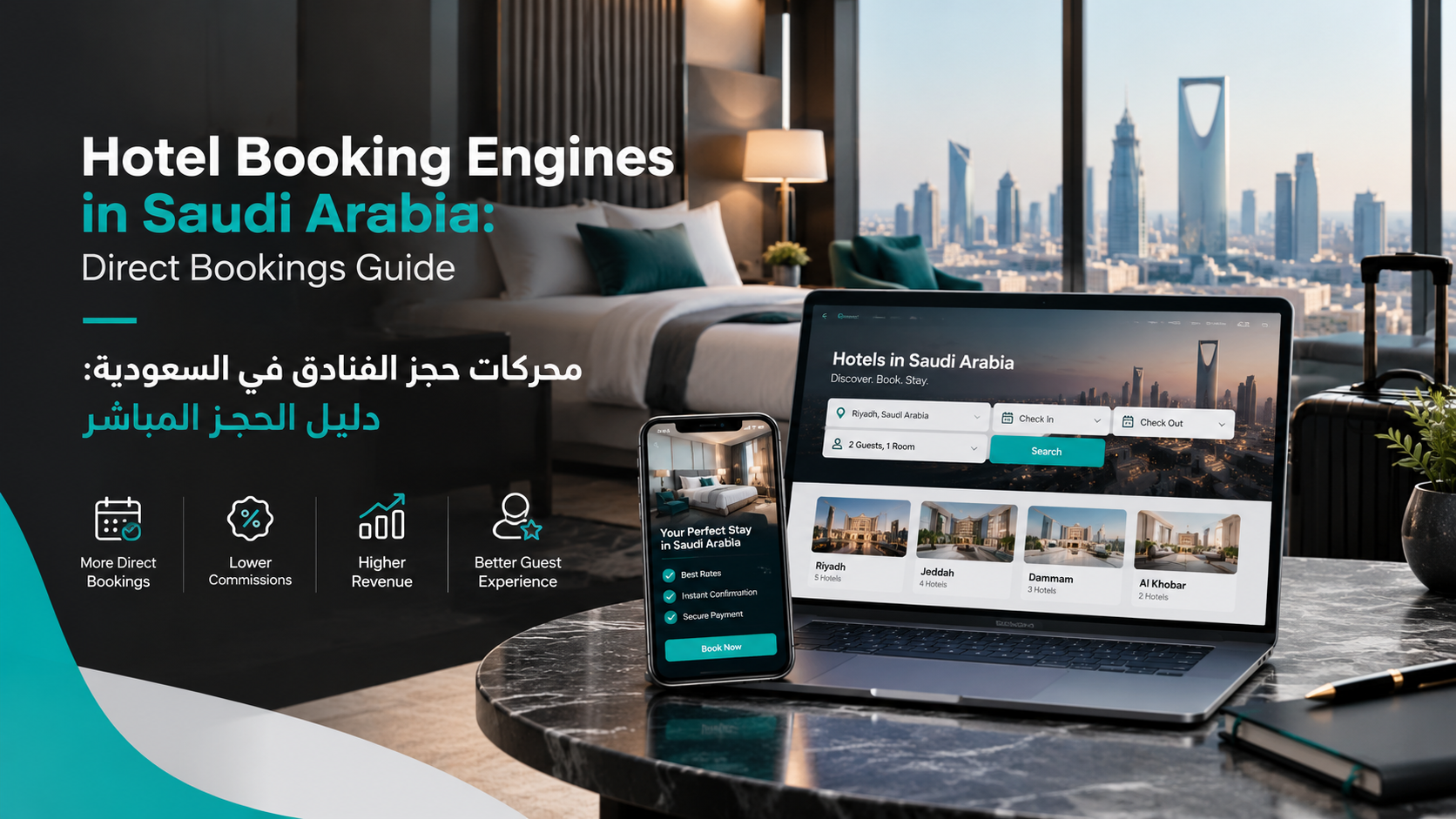
A hotel booking engine in Saudi Arabia is the software on a hotel's own website and app that lets guests check live availability, see prices in Saudi riyals with VAT, pay through Mada, Apple Pay or cards, and receive instant confirmation, without going through a third-party platform. A well-built booking engine improves the guest booking journey by making it faster, clearer and more trustworthy, while helping hotels reduce commission costs, increase direct revenue and collect first-party guest data that supports personalised service.
Every hotel stay in Saudi Arabia begins with a decision made on a screen. A family in Riyadh planning an Eid trip to Al Khobar, a business traveller from Jeddah heading to Dammam, or a pilgrim in Jakarta arranging accommodation in Madinah all pass through the same moment: they choose a hotel, they try to book it, and they either finish in two minutes or give up in frustration.
That moment is controlled by the hotel booking engine. It is the most important piece of technology on a hotel's website, yet it is often the most neglected. Many Saudi hotels still rely almost entirely on online travel agencies (OTAs) for reservations, paying commissions of 15 to 25 percent on every booking while their own website functions as little more than a digital brochure.
The Saudi market makes this issue urgent. The Kingdom recorded more than 100 million visits in 2023 and has raised its Vision 2030 target to 150 million annual visits. Domestic tourism is booming, smartphone penetration is among the highest in the world, and digital payments through Mada, Apple Pay and STC Pay are second nature to Saudi consumers. Guests who pay for coffee with a tap of their phone expect to book a hotel room the same way.
This article explains what a modern direct booking engine is, how it improves the guest booking journey at every step, what features matter most in the Saudi context, and how hotel owners and operators can use it to grow direct revenue. We also share how Dyafa Hotels & Resorts approaches booking technology across its properties in Saudi Arabia.
A hotel booking engine is an application embedded in the hotel's website, mobile app or social channels that connects directly to the hotel's inventory and rates. When a guest selects dates, the engine checks real-time availability, displays room types and prices, applies promotions, collects guest details, processes payment and sends a confirmation. Behind the scenes, it writes the reservation into the property management system (PMS) and updates availability across all other channels through a channel manager.
The key difference between a direct booking engine and an OTA is ownership of the relationship. When a guest books through a third-party platform, the platform owns the guest's data, controls the communication and charges a commission. When a guest books directly, the hotel owns the data, can communicate freely before and after the stay, and keeps the full room revenue. Over hundreds of bookings a month, this difference decides a hotel's profitability.
Key Insight
A booking engine is not a website feature; it is a revenue channel. If a 120-room hotel in Riyadh shifts just 15 percent of its OTA bookings to direct at an average rate of SAR 600, the commission saved alone can exceed SAR 500,000 a year, before counting upsells and repeat business.
The online hotel booking journey has six steps. At each one, a poorly designed engine loses guests and a well-designed engine wins them.
Most Saudi guests arrive from a mobile search, an Instagram or Snapchat link, or an AI assistant's recommendation. The booking widget must be visible immediately, load in under three seconds on 4G or 5G, and default to the guest's language. A "Book Now" button that leads to a slow, English-only third-party page is where the first 30 percent of potential guests leave.
Guests want clarity: which rooms are available, what is included, and what it costs in total. Modern engines show room photos, occupancy limits, bed types, and the final price including 15 percent VAT and municipality fees. Hijri calendar support and awareness of Saudi public holidays and school breaks make date selection natural for domestic travellers.
This is where the direct channel wins or loses against OTAs. Rate-parity rules mean the room price is often identical, so the engine must show direct booking benefits clearly: free breakfast, flexible cancellation, late checkout, loyalty points or a member rate. A simple "Best price guaranteed when you book direct" message, backed by an actual comparison, is one of the most effective conversion tools in the Saudi market.
Long forms kill bookings. The best engines ask for the minimum: name, mobile number, email and payment. Autofill, Apple Pay and saved-profile logins reduce the process to a few taps. Asking for a national ID or Iqama number at this stage is unnecessary; it can be collected at digital check-in.
Payment is where trust is tested. Saudi guests expect Mada as the first option, followed by Apple Pay and international cards. A payment page that redirects to an unfamiliar foreign gateway, shows prices in US dollars, or fails 3-D Secure verification loses the booking instantly. Flexible options such as pay-at-hotel with card guarantee, or split payments, further improve conversion for domestic leisure travellers.
The journey does not end with a confirmation number. An engine integrated with messaging sends a WhatsApp confirmation, a reminder a few days before arrival, an invitation to complete digital check-in and a relevant upgrade offer. Because WhatsApp is the dominant channel in Saudi Arabia, this single integration often doubles pre-arrival engagement compared with email.
"A guest who books directly is not just a reservation. They are a relationship the hotel controls from the first click to the next visit. Every commission we avoid is money we can reinvest in the guest experience." — Commercial perspective, Dyafa Hotels & Resorts
Not every booking engine is built for Saudi Arabia. When evaluating hotel booking software, owners and operators in the Kingdom should look for the following features.
Practical Tip
Test your own booking engine on a mid-range Android phone over mobile data, in Arabic, paying with Mada. Time the full process from homepage to confirmation. If it takes more than three minutes or more than five screens, guests are abandoning it. Most Saudi hotels discover their biggest conversion problems in this ten-minute exercise.
Corporate travellers book late, book often and value speed. A booking engine with saved corporate profiles, negotiated company rates accessible by code, instant invoicing to the employer and integration with expense systems captures this segment directly. In the Eastern Province, where Dyafa Hotels & Resorts is headquartered, energy-sector and industrial travel to Al Khobar, Dammam and Jubail creates steady weekday demand that a corporate-friendly direct channel serves far better than OTAs.
Pilgrims often book months in advance, in groups, from many countries. Engines serving this segment need multi-currency display, multilingual interfaces (Urdu, Bahasa, Turkish and French alongside Arabic and English), group booking capabilities and integration with the Nusuk platform ecosystem. Clear proximity information to the Haram and shuttle details are decisive factors.
Families compare carefully and book around school holidays, Eid and long weekends. Engines that display family rooms, connecting options, children's policies, pool and beach access, and Eid packages convert this segment well. Flexible cancellation is essential because family plans change.
Domestic tourism is the largest and fastest-growing part of the Saudi market. Mid-scale brands, including Dyafa's own Dyafa Inn concept, depend on high booking volumes at efficient cost. A lean, fast, Arabic-first booking engine with WhatsApp confirmation and Mada payment is the difference between profitable direct volume and permanent OTA dependence.
Riyadh Season, Formula 1 in Jeddah, the Esports World Cup, exhibitions and future events such as Expo 2030 create sharp peaks. A booking engine linked to revenue management software adjusts rates in real time and lets the hotel capture demand directly rather than handing peak-season margin to platforms.
The table below compares the two approaches from the perspective of a Saudi hotel owner. Most successful hotels use both, but the balance between them determines profitability.
| Factor | OTA-Only Distribution | Direct Booking Engine |
|---|---|---|
| Cost per booking | 15–25% commission on every reservation | Fixed software fee plus payment processing, typically 3–5% equivalent |
| Guest data | Owned by the platform; masked emails | Owned by the hotel; full profile and preferences |
| Pricing control | Limited by platform rules and promotions | Full control over rates, packages and policies |
| Upsell revenue | Minimal; platform controls the flow | Upgrades, transfers, dining and late checkout at booking and pre-arrival |
| Communication | Through platform messaging only | Direct WhatsApp, SMS and email before and after the stay |
| Reach | Very high, especially for international guests | Depends on the hotel's marketing, SEO and brand |
| Repeat business | Guest returns to the platform, not the hotel | Loyalty programme and personalised offers drive return stays |
| Best role | Acquisition of new and international guests | Conversion of domestic, repeat and corporate guests |
The lesson is balance. OTAs remain valuable for reaching first-time international guests who have never heard of a property. The direct booking engine converts those guests into repeat direct customers and captures the domestic and corporate demand that already knows the hotel.
Dyafa Hotels & Resorts is a Saudi hospitality group based in Al Khobar. It operates through Dyafa Operations & Maintenance Company, which manages hotel operations, and Aqar Al Dyafa, the group's real-estate arm responsible for hospitality assets, and develops its own mid-scale brand, Dyafa Inn.
Because the group both owns assets and operates hotels, booking technology is judged by its effect on the owner's bottom line and the guest's experience at the same time. The approach rests on four principles:
For owners who sign a hotel management agreement with Dyafa, this means the direct booking channel is part of the operating framework from day one, rather than an afterthought added once OTA dependence has already taken hold.
Vision 2030 targets 150 million annual visits and a tourism contribution of around 10 percent of GDP. Achieving this requires hotels that can convert demand efficiently at scale. Five trends will shape the future of hotel booking in Saudi Arabia.
Generative AI assistants are moving from recommending hotels to booking them. Hotels whose booking engines expose clean availability data and secure booking APIs will be bookable by AI agents; those that do not will be invisible in this new channel. Structured data, clear policies and machine-readable rates are becoming essential.
Given WhatsApp's dominance in the Kingdom, booking through a conversation, with the guest asking for a room, receiving options and paying by link, all inside the chat, is the natural next step. Arabic-language AI models make this practical for domestic guests.
As Saudi digital identity infrastructure matures, booking and check-in will merge: a guest verifies identity once, and the booking engine, PMS and door lock all recognise them. Repeat bookings become a single confirmation tap.
Giga-projects such as the Red Sea, Diriyah, Qiddiya and AlUla are building destination-level platforms where hotels, experiences and transport are booked together. Hotel booking engines will need to plug into these ecosystems and into national platforms such as Nusuk and Visit Saudi.
Booking engines will offer member rates, loyalty-based pricing and tailored packages based on consented guest data, while the Personal Data Protection Law ensures guests keep control over how their information is used.
Note
Payment regulations, e-invoicing phases and data protection requirements in Saudi Arabia are updated regularly. Before selecting or changing a booking engine, hotel owners should confirm current requirements with the Saudi Central Bank (SAMA) for payments, ZATCA for e-invoicing and the Ministry of Tourism for guest reporting.
A hotel booking engine is software integrated into a hotel's website or app that allows guests to check real-time availability, view prices, select rooms and pay directly, without using a third-party platform. It connects to the hotel's property management system so reservations and availability update automatically.
OTAs charge 15 to 25 percent commission and keep the guest's data. A direct booking engine lets the hotel keep the full room revenue, own the guest relationship, sell upgrades and communicate directly through WhatsApp. Most successful Saudi hotels use OTAs to attract new guests and their own booking engine to convert domestic, corporate and repeat guests.
At minimum: Mada, Visa, Mastercard and Apple Pay. STC Pay and buy-now-pay-later services are increasingly valuable for domestic leisure guests. Prices should be displayed in Saudi riyals with VAT included, and the gateway should be licensed by the Saudi Central Bank.
Pricing models vary: some providers charge a fixed monthly fee, others a small percentage per booking, typically far below OTA commissions. Payment processing adds a further percentage. For most hotels, the total cost of direct bookings is a fraction of the commission paid on the same bookings through an OTA.
Offer clear direct-booking benefits such as free breakfast or flexible cancellation, ensure the engine works perfectly in Arabic on mobile with Mada payment, connect to Google Hotels metasearch, use WhatsApp for confirmations and abandoned-booking reminders, run a simple loyalty programme, and optimise the website for search engines and AI assistants.
Yes. Hotels in Saudi Arabia must issue compliant electronic invoices. A booking engine that passes reservation and payment data correctly into the PMS and invoicing system ensures each booking produces a compliant e-invoice with the correct VAT breakdown.
Advanced booking engines support group and multi-room reservations, multiple currencies and languages, and long lead times. Hotels in Makkah and Madinah should confirm that the engine can handle these requirements and integrate with the Nusuk platform ecosystem.
Yes. Through Dyafa Operations & Maintenance Company, the group sets up and manages the full commercial and technology framework, including the direct booking engine, for hotels it operates across Saudi Arabia. Owners can reach the team at [email protected] or through dyafa.com.
The hotel booking engine in Saudi Arabia has moved from a technical detail to a strategic asset. It determines whether a guest completes a reservation in two minutes or abandons it, whether the hotel keeps its full room revenue or pays a quarter of it in commission, and whether the guest relationship belongs to the hotel or to a platform.
A modern direct booking engine built for the Saudi market is mobile-first and Arabic-first, accepts Mada and Apple Pay, shows transparent prices in riyals, connects to WhatsApp, integrates with the PMS and channel manager, and complies with ZATCA and PDPL requirements. It improves the guest booking journey at every step and gives hotel owners the data, control and margin they need to grow.
As Saudi Arabia moves toward 150 million visitors, Expo 2030 and the FIFA World Cup 2034, the hotels that invest in their direct channel today will be the ones that convert tomorrow's demand into loyal, profitable, repeat guests.
Dyafa Hotels & Resorts partners with owners across Saudi Arabia to operate, open and optimise hotels with a technology-enabled commercial framework built for the Saudi guest. Let's discuss how your property can reduce OTA dependence and build a stronger direct channel.
Email: [email protected] · Phone: 9200 6655 · 2876 Prince Turki Road, Al Khobar 34611, Saudi Arabia
Tags
hotel booking engine Saudi Arabia, direct booking engine, guest booking journey, hotel booking software Saudi Arabia, online hotel booking journey, direct bookings vs OTA, increase direct bookings Saudi hotels, hotel booking engine with Mada payment, Arabic hotel booking engine, mobile hotel booking Saudi Arabia, hotel channel manager Saudi Arabia, WhatsApp hotel booking confirmation, best hotel booking engine for Saudi hotels, how to reduce OTA commission for hotels, hotel booking engine ZATCA e-invoicing, Umrah hotel group booking engine, Vision 2030 hotel technology, hotel management company Saudi Arabia, Dyafa Hotels and Resorts, Dyafa Inn, hotel operations Al Khobar, Eastern Province hotels, Saudi hospitality technology trends 2026, hotel revenue management Saudi Arabia, metasearch Google Hotels direct booking



© Copyright 2024 Dyafa - All Rights Reserved | Created By Fandaqah Information Technology