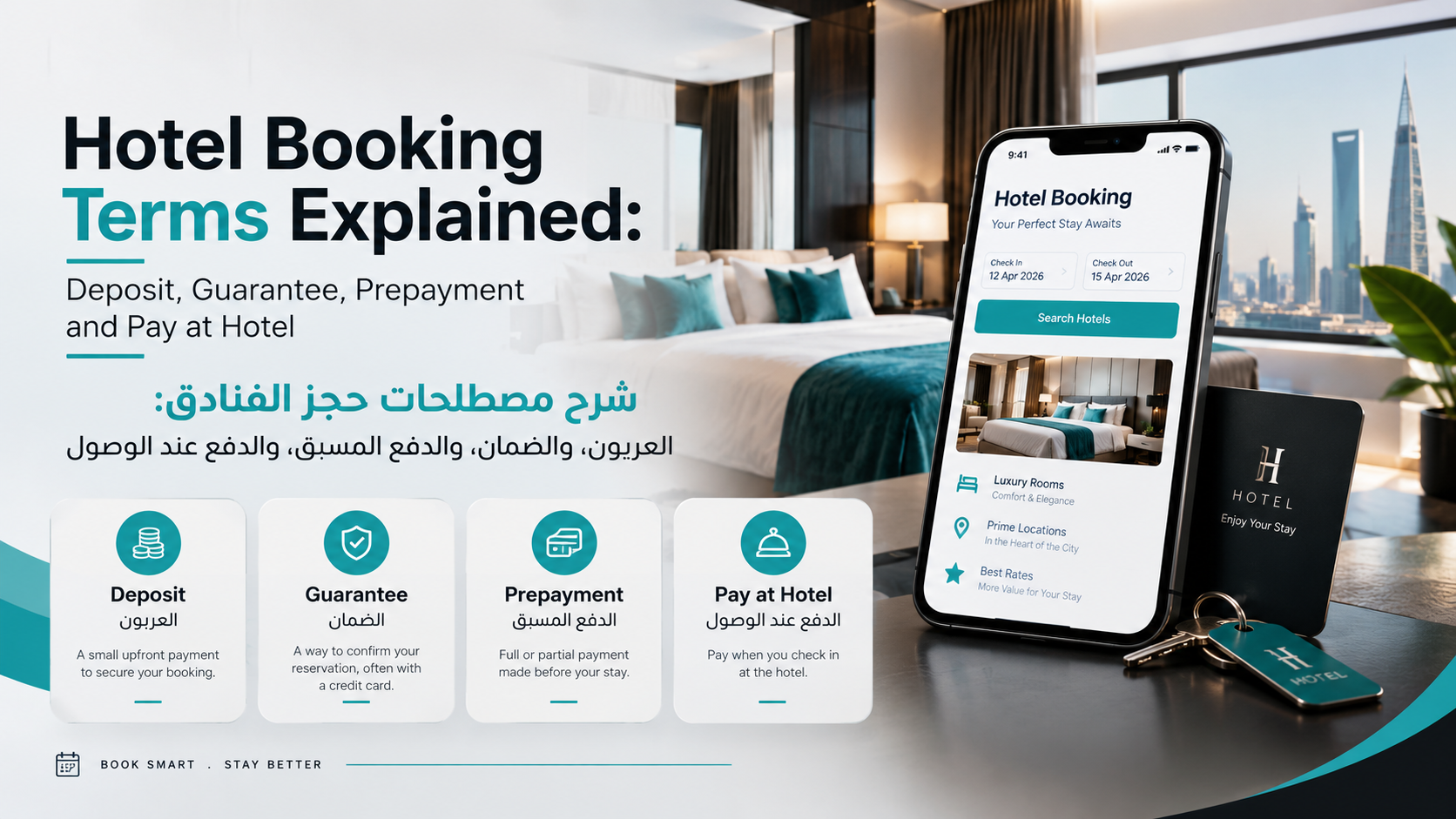

Dyafa Travel Guide · Saudi Arabia
Understand exactly when you pay, what you risk, and how to choose the right booking option for Umrah trips, family holidays, business stays, and peak-season travel across the Kingdom.
You find the perfect hotel, select your dates, and suddenly the booking page shows several prices for the same room: "Pay at Hotel," "Prepaid," "Deposit Required," "Guaranteed by Credit Card." Some are cheaper, some are refundable, and some will charge your card today. Without a clear understanding of these words, it is easy to pay more than you need to, or lose money when plans change.
This guide gives you hotel booking terms explained in plain language. We break down the four most common payment models, the hotel deposit, the guaranteed booking, hotel prepayment, and pay at hotel, and show you how each one affects your money, your flexibility, and your peace of mind.
For travelers in Saudi Arabia, these terms matter more than ever. Peak seasons such as Ramadan, Eid holidays, school breaks, Riyadh Season, and major events create high demand, and hotels protect themselves with stricter payment rules. Knowing how a cancellation policy, a credit card pre-authorization, or a no-show fee works will help you book with confidence, whether you are planning hotel booking in Saudi Arabia for a weekend on the Al Khobar Corniche or a week of meetings in Riyadh.
Quick Answer
Deposit: you pay part of the booking in advance to secure the room. Guarantee: you provide card details so the hotel can charge you if you do not show up or cancel late, but usually nothing is charged at booking. Prepayment: you pay the full amount in advance, often at a lower price but with fewer refund options. Pay at Hotel: you pay when you check in or check out, which gives the most flexibility but is often slightly more expensive.
Choose prepayment when your plans are certain, and a flexible, guaranteed or pay-at-hotel rate when your plans might change.
Every hotel rate has two parts: the price and the conditions. The conditions decide when you pay, how much you pay upfront, and what happens if you cancel or do not arrive. Hotels use different payment models to balance two goals: giving guests flexibility, and protecting the hotel from empty rooms caused by last-minute cancellations. Here is how each model works.
A hotel deposit is a partial payment made in advance to secure your reservation. It might be the cost of the first night, a fixed percentage of the total stay, or a set amount for group and event bookings. The remaining balance is usually paid at check-in or check-out.
Deposits are common for longer stays, group bookings, wedding and event room blocks, and high-demand dates. Whether a deposit is refundable depends entirely on the cancellation policy. Some deposits are fully refundable if you cancel before a deadline, while others are kept by the hotel once paid.
There is also a second, different use of the word "deposit": the security deposit or incidental deposit. This is an amount the hotel holds at check-in to cover extras such as room service, minibar items, laundry, or damage. It is usually released after check-out if nothing is owed.
A guaranteed booking means the hotel promises to hold your room for the full arrival night, even if you arrive very late. In return, you guarantee payment, usually by giving credit card details. In most cases, the card is not charged when you book. It is only charged if you cancel after the deadline or fail to arrive, which is known as a no-show.
The opposite is a non-guaranteed booking. Here the hotel may hold your room only until a certain time on the arrival day, often in the evening. If you have not arrived or called by then, the room may be released to other guests, especially during busy periods. For travelers landing on late flights into Riyadh, Jeddah, or Dammam, a guaranteed booking is often essential.
Hotel prepayment means paying the full cost of your stay at the time of booking or before arrival. Prepaid rates are frequently linked to a non-refundable rate, meaning you will not get your money back if you cancel, change dates, or do not show up. In exchange, prepaid rates are usually cheaper than flexible rates.
Not all prepaid rates are non-refundable. Some hotels offer prepaid rates that can be cancelled for a refund until a specific date. The key is to read the rate conditions carefully, not just the word "prepaid."
Pay at hotel means you pay nothing upfront and settle the bill at the property, either at check-in or check-out. This is the most flexible option and is popular with travelers whose plans may change. However, "pay at hotel" does not always mean "no conditions." Many pay-at-hotel rates still require card details as a guarantee, and a cancellation or no-show fee may still apply if you cancel late.
"The cheapest rate is not always the best value. The best rate is the one whose conditions match how certain your plans really are." — Dyafa Hotels & Resorts Reservations Insight
The table below compares the four payment models side by side. Use it to quickly see when money leaves your account and how much risk you carry if plans change.
| Factor | Deposit | Guarantee | Prepayment | Pay at Hotel |
|---|---|---|---|---|
| Paid at booking | Part of the total | Usually nothing | Full amount | Nothing |
| Card details needed | Yes | Yes | Yes | Often yes |
| Typical price | Standard | Standard | Often lowest | Standard or higher |
| Flexibility | Medium | High until deadline | Low if non-refundable | Highest |
| Risk if you cancel late | May lose deposit | Fee, often first night | May lose full amount | Fee may still apply |
| Room held for late arrival | Yes | Yes | Yes | Only if guaranteed |
| Best for | Groups, long stays, events | Business trips, late flights | Fixed dates, budget savings | Uncertain plans |
Note: These are general patterns across the hotel industry. Exact conditions differ between hotels and between rates at the same hotel, so always read the specific rate rules before you confirm.
The Break-Even Test: Should You Choose the Non-Refundable Rate?
Here is a simple calculation to decide between a flexible rate and a cheaper prepaid, non-refundable rate.
Example: a 3-night stay costs SAR 1,500 on the flexible rate and SAR 1,350 on the non-refundable rate. You save SAR 150 by prepaying, but you risk losing SAR 1,350 if you cancel.
Divide the saving by the amount at risk: 150 ÷ 1,350 ≈ 11%. That is your break-even point.
If you believe there is less than an 11% chance your plans will change, the non-refundable rate is good value. If the chance is higher, for example because your trip depends on a work schedule or a visa, the flexible rate is the smarter choice.
One of the most common surprises for guests is seeing money "missing" from their card after check-in, even when they booked a pay-at-hotel rate. This is usually a credit card pre-authorization, a temporary hold rather than a final charge.
Hotels typically place a hold to cover the room total, an incidental amount for extras, or both. For example, on a two-night stay at SAR 450 per night, a hotel might hold the room cost plus a set amount for incidentals. When you check out and settle your bill, the hotel charges the final amount and releases the rest of the hold.
💡 Pro Tip: Use a Credit Card for Holds
If you have the choice, use a credit card rather than a debit card for the guarantee and incidental hold. A hold on a credit card reduces your available credit limit, while a hold on a debit card temporarily locks money in your bank account. You can still pay your final bill with mada or another method at check-out.
The right payment model depends on your trip. These common scenarios from travel across the Kingdom show how to match the booking option to your situation.
A family books rooms near the Haram for the last ten nights of Ramadan. Demand is extremely high, and many hotels require prepayment or significant deposits for these dates. Recommendation: book early and read the cancellation policy carefully. If dates are fixed and travel arrangements are confirmed, a prepaid rate can secure the room and the best price. If visas or flights are still pending, look for a rate with a clear refund deadline, even if it costs more.
A sales manager plans three nights in Riyadh, but meeting dates may shift. Recommendation: a guaranteed, flexible rate. The room is held even if the flight lands late, and free cancellation protects against schedule changes. The small price difference compared to a non-refundable rate is worth the flexibility.
A family from Riyadh books two connecting rooms for an Eid weekend on the Corniche. Dates are fixed around the holiday. Recommendation: prepayment or a deposit. Eid weekends fill quickly in the Eastern Province, so securing the rooms early with a deposit or prepaid rate makes sense when the plan is certain.
A traveler lands at King Fahd International Airport in Dammam after midnight. Recommendation: always use a guaranteed booking. A non-guaranteed reservation could be released before arrival during a busy period. Adding a note with your flight number and expected arrival time to the booking also helps the hotel prepare.
A company books fifteen rooms for a regional conference, or a family reserves rooms for wedding guests. Recommendation: a deposit agreement with clear release dates. Group bookings typically require a deposit, and the agreement should state how many rooms can be released without penalty and by which date.
📝 Note: Third-Party Sites vs Booking Direct
When you book through a third-party travel website, the payment may be collected by that website rather than the hotel, and refunds or changes may need to go through them. Booking directly with the hotel usually makes it easier to understand the conditions, request changes, and speak to someone who can help.
Most unexpected hotel charges come from small details that guests miss. Follow these steps every time you book:
Dyafa Hotels & Resorts is a Saudi hospitality group headquartered on Prince Turki Road in Al Khobar. As a local operator, our reservations teams deal every day with the realities of travel in the Kingdom: Ramadan and Eid peaks, family bookings with several rooms, business travelers with changing schedules, and guests arriving late on regional flights.
That experience shapes how we help guests choose a rate. Rather than simply showing the lowest price, we explain what each rate means so you can choose the one that fits your plans:
Check the conditions for each rate on dyafa.com, or contact the Dyafa team at [email protected] or 9200 6655.
Hotel booking and payment in the Kingdom are changing quickly. Under Saudi Vision 2030, tourism is a central pillar of economic diversification, with a national target of 150 million annual visits by 2030. At the same time, the Kingdom has moved rapidly toward digital payments. The Financial Sector Development Program set a goal for non-cash payments to reach 70% of retail transactions by 2030, a target the Saudi Central Bank reports has already been passed.
With mada, Apple Pay, and local digital wallets widely used, guests increasingly expect to prepay, pay deposits, and settle bills from their phones. Contactless check-out and digital receipts are becoming the norm.
As more international visitors arrive, guests expect cancellation rules, taxes, and holds to be explained clearly before they book. Hotels that present terms honestly build stronger trust and loyalty.
Major events, including Expo 2030 Riyadh and the FIFA World Cup 2034, along with annual seasons and festivals, will create intense demand periods. Expect more prepaid rates, deposits, and longer cancellation windows during these dates.
Travelers are learning that flexibility has value. Many hotels now offer a clear choice: a lower non-refundable price or a slightly higher flexible price, letting guests decide which risk they prefer.
As hotel websites and apps improve, more guests book directly to get clearer conditions, easier changes, and direct communication with the property.
✅ The 3-Question Booking Rule
Before you confirm, always check three things: the cancellation deadline, the amount charged today, and whether taxes are included.
A deposit is a partial payment made in advance to secure the room, with the balance paid later. Prepayment means paying the full amount of the stay in advance. Prepaid rates are often cheaper but are more likely to be non-refundable.
A guaranteed reservation means the hotel will hold your room for the entire arrival night, even if you arrive late. You guarantee payment, usually with a card, and you may be charged a fee if you cancel after the deadline or do not arrive.
Pay at hotel is more flexible because no money is taken before arrival, which makes it safer if your plans might change. A prepaid booking is often cheaper and secures your room, but you may lose your money if you cancel a non-refundable rate.
Hotels place a temporary pre-authorization hold to make sure funds are available for the room and any extras. The hold is released after check-out, although your bank may take several business days to show the funds as available again.
Cancel before the deadline and keep written confirmation, tell the hotel in advance if you will arrive late, and contact the hotel to change your dates instead of not showing up. Always save a copy of the rate conditions when you book.
Many hotels in Saudi Arabia accept mada cards for payment at the property. Some hotels may still prefer a credit card for the booking guarantee or incidental hold, so check the hotel's accepted payment methods before you arrive.
A non-refundable rate is worth it when your plans are certain. Divide the money you save by the amount you would lose if you cancelled. If the chance of your plans changing is lower than that percentage, the non-refundable rate is good value.
For Umrah trips during peak periods such as Ramadan, book early. Choose a prepaid rate only when your visa, flights, and dates are confirmed. If anything is still uncertain, a rate with a clear free-cancellation deadline gives you better protection.
With hotel booking terms explained clearly, the choice becomes simple. A hotel deposit secures your room with part of the payment. A guaranteed booking holds your room through the night in exchange for a payment promise. Hotel prepayment gives you the best price when plans are fixed. Pay at hotel gives you the most freedom when plans might change.
For travelers in Saudi Arabia, where Ramadan, Eid, school holidays, and major events create strong demand, understanding these terms is the difference between a smooth booking and an unexpected charge. Use the comparison table, the break-even test, and the 3-question rule, and always check the cancellation deadline, the amount charged today, and whether taxes are included. That is how you book smarter every time.
Book With Confidence
Not Sure Which Rate Is Right for You?
Tell the Dyafa team your dates and how fixed your plans are, and we will explain every rate condition clearly, so you choose the option that protects your money and fits your trip.
Call 9200 6655 or email [email protected]
Tags:
hotel booking terms explained, hotel deposit, guaranteed booking, hotel prepayment, pay at hotel, non-refundable rate, flexible hotel rate, hotel cancellation policy, credit card pre-authorization, hotel no-show fee, hotel booking Saudi Arabia, what is the difference between deposit and prepayment in hotel booking, is pay at hotel safer than prepaid booking, why does a hotel hold money on my card, what does guaranteed reservation mean, how to avoid no-show charges in Saudi hotels, can I pay with mada at hotel, best booking option for Umrah trip, Saudi Vision 2030 tourism, Dyafa Hotels and Resorts



© Copyright 2024 Dyafa - All Rights Reserved | Created By Fandaqah Information Technology