
Dyafa Hotels & Resorts | Updated October 2026 | Reading time: 12 minutes
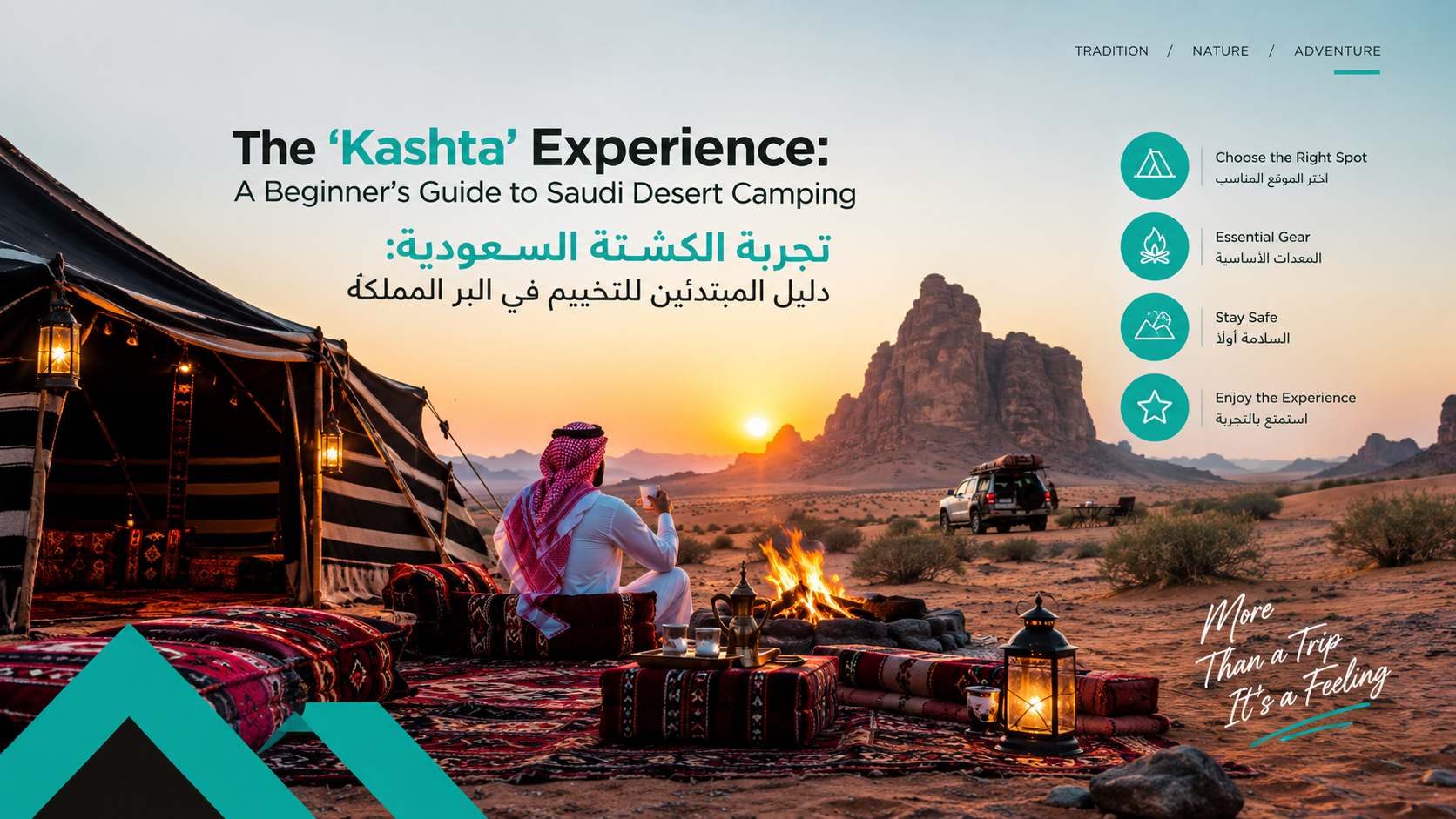
Saudi desert camping, known locally as a kashta (كشتة), is one of the most loved weekend traditions in the Kingdom. When the first cool breeze of November arrives, families in Riyadh, Qassim, Hail, Jeddah and the Eastern Province load their cars with tea kettles, firewood and blankets and head to the open sand. If you are new to the idea, this beginner's guide to kashta explains everything: what a kashta really is, how to plan one, what to pack, where to go, how to stay safe and how the desert camping experience in Saudi Arabia is changing under Vision 2030.
Whether you are a resident who has never joined a desert trip, an expat curious about local culture, or a visitor planning a Saudi desert adventure, you will finish this guide knowing exactly how to enjoy your first kashta with confidence.
Quick answer
A kashta is a relaxed Saudi desert outing built around a fire, Arabic coffee, grilled food and good company. The best season is November to March. Beginners should start with a half-day trip near their city, bring more water than they think they need, and go with people who know the area.
In this guide
The word kashta comes from the Arabic verb meaning "to go out" or "to roam". In Saudi Arabia and across the Gulf, it describes any informal outdoor trip, but in everyday use it almost always means a desert outing. A kashta can be as short as an afternoon of tea on a sand ridge outside Riyadh, or as long as a three-day Saudi desert camping trip in the Nafud or the Empty Quarter.
What makes the kashta special is not the equipment. It is the rhythm. People arrive in the late afternoon, choose a flat spot sheltered from the wind, lay out carpets and cushions, and light a fire. Arabic coffee (qahwa) is prepared, dates are shared, and the evening slowly unfolds with conversation, grilled meat (mandi or kabsa cooked on coals), card games, poetry and, in winter, a sky full of stars that city residents rarely see.
For many Saudi families, the kashta is a weekly winter ritual. It brings generations together: grandparents tell stories of the Bedouin past, parents manage the fire, and children run across the dunes. Groups of friends organise their own trips, often with a dedicated "kashta kit" that stays packed in the car all season. This is why desert camping in Saudi Arabia feels different from camping in Europe or North America. It is less about hiking and survival and more about hospitality, food and connection.
"In the desert, hospitality is the first law. A kashta is simply the modern way of keeping that law alive: open fire, open heart, open door." — A reflection often shared by Najdi elders during winter kashta evenings
Planning a beginner desert camping trip in Saudi Arabia is easier than most people think, but a little preparation makes the difference between a memorable night and an uncomfortable one.
The best time for desert camping in Saudi Arabia is from November to March. In Riyadh, Qassim and Hail, daytime temperatures in December and January sit comfortably between 15°C and 24°C, while nights can drop below 5°C. Thursday and Friday evenings are the busiest; if you prefer quiet, go on a weekday or arrive early to claim a good spot.
Start close to home. Most major Saudi cities have popular kashta spots within 30 to 60 minutes' drive, reachable by a normal car on firm ground. Save the deep dunes and remote wadis for later, once you have a few trips behind you and ideally a 4x4 with recovery gear.
Will it be a half-day kashta (afternoon tea and sunset, home by 10 pm) or an overnight desert camping trip? Beginners usually enjoy a half-day outing first. It lets you learn the basics, test your equipment, and see how your group handles the cold before committing to a full night.
Experienced kashta groups work like a team: one person owns the fire and coals, one handles the coffee and tea, one brings the food, and one is responsible for navigation and safety. Dividing tasks keeps the evening relaxed and avoids the classic "everyone brought dates, nobody brought water" problem.
Check the forecast the day before and again on the morning of the trip. Two things cancel a kashta: strong wind (sand in the food and a fire that will not cooperate) and rain. Rain is rare, but wadis can flood quickly, so never camp in a dry riverbed when rain is forecast anywhere upstream.
Beginner tip
Arrive at least 90 minutes before sunset. You need daylight to pick a safe spot, set up carpets and tents, and get the fire going. Setting up in the dark is the number one frustration of first-time desert campers.
A well-prepared kashta packing list covers four areas: comfort, food and drink, fire and light, and safety. Here is a complete checklist that works for both a short outing and an overnight stay.
Note on the environment
Saudi Arabia's National Center for Vegetation Cover enforces fines for cutting trees or shrubs and for leaving waste in protected areas. A responsible kashta means bringing your own firewood, using a fire tray, and leaving the site exactly as you found it.
Why do millions of residents repeat the kashta every winter weekend? Beyond tradition, the desert camping experience offers real benefits that modern city life rarely provides.
The Kingdom is vast, and every region has its own flavour of desert camping. Here are the most popular kashta destinations in Saudi Arabia and who they suit best.
The Thumamah area north of Riyadh is the classic kashta ground for the capital, with flat spaces and easy access by regular car. The Red Sand Dunes on the Riyadh–Dammam road are ideal for families who want sandboarding and photos. For a more dramatic setting, the cliffs of the Edge of the World (Jebel Fihrayn) make a stunning day-trip kashta, best combined with a guided tour.
The golden dunes of the Nafud around Hail and Qassim are among the most beautiful desert landscapes in the Kingdom. This is where you will find the most authentic Bedouin-style kashta culture, with camel farms, winter festivals and warm hospitality. A 4x4 is recommended for deeper dune areas.
Residents of Dammam, Dhahran and Al Khobar enjoy a unique combination: beach kashta at Half Moon Bay and classic sand camping inland. Many families alternate between the two depending on the weather.
AlUla has transformed into a world-class destination where desert glamping sits beside ancient Nabataean heritage. It is the perfect choice for tourists who want a premium Saudi desert experience with hospitality standards, guided stargazing and curated dining.
The largest sand desert on earth is not for beginners alone, but with a licensed tour operator it becomes the ultimate kashta: towering dunes, silence and a night sky that feels infinite. Multi-day expeditions depart from Sharurah and the southern Eastern Province in winter.
One of the most common questions from beginners is whether to organise everything themselves or book a hosted experience. The table below compares the three main formats of desert camping in Saudi Arabia.
| Criteria | Traditional Kashta | Desert Glamping | Luxury Desert Resort |
|---|---|---|---|
| Setup | Self-organised, own gear | Pre-set furnished tents | Permanent villas or suites |
| Typical cost per person | Low (fuel, food, firewood) | Medium | High |
| Bathrooms & showers | None (or portable) | Shared or en-suite | Private en-suite |
| Food | You cook on coals | Catered buffet or BBQ | Restaurant and in-tent dining |
| Cultural authenticity | Highest | High (hosted traditions) | Curated and refined |
| Best for | Locals, groups of friends, families with gear | Beginners, expats, tourists | Couples, premium travellers, special occasions |
| Effort required | High | Low | Minimal |
Our recommendation for absolute beginners: try a guided glamping night first to learn the rhythm of the desert, then graduate to your own traditional kashta with friends. Many Saudi hospitality groups, including the properties and experiences you can explore on dyafa.com, now bridge both worlds by offering authentic kashta evenings with hotel-grade comfort.
Did you know?
The Saudi Tourism Authority reports that domestic tourism has become a major pillar of the Kingdom's travel economy, with winter desert and nature experiences among the fastest-growing categories. The humble kashta is now part of a national tourism strategy.
Vision 2030 has set a clear goal: make Saudi Arabia one of the world's top tourism destinations and raise the sector's contribution to GDP to 10 percent. Desert tourism sits at the centre of that ambition, and the traditional kashta is evolving fast.
Developments such as AlUla, Diriyah, the Red Sea destination and NEOM are building luxury desert and nature resorts that combine heritage with world-class hospitality. The result is a new category: the premium kashta, where the fire and coffee remain, but the tent has air conditioning and a spa next door.
The Ministry of Tourism now licenses desert camps and glamping operators, raising safety, hygiene and service standards. For beginners, this means more reliable options and clearer expectations when booking a desert camping experience online.
Events such as the Riyadh Season and regional winter festivals in Hail, Qassim and Tabuk have turned kashta season into a calendar of activities: camel racing, falconry shows, traditional markets and stargazing nights organised near popular camping grounds.
With the Saudi Green Initiative targeting the planting of 10 billion trees and the protection of 30 percent of the Kingdom's land, eco-conscious camping is becoming the norm. Expect to see solar-powered camps, waste-free policies and protected-area rules that keep the desert beautiful for the next generation of kashta lovers.
Apps now help campers find licensed sites, check weather and dune conditions, and book gear rental delivered to the desert. Mobile network coverage continues to expand, making remote kashta trips safer without removing the sense of escape.
For hospitality groups such as Dyafa Hotels & Resorts, these trends open a clear opportunity: to pair hotel stays in Saudi cities with authentic, well-organised desert experiences that let guests enjoy the kashta without the logistics.
Kashta (كشتة) is the Saudi and Gulf word for a casual outdoor trip, most often a desert outing with family or friends. It includes Arabic coffee, tea, a fire, grilled food and relaxed conversation, and can last a few hours or a full weekend of desert camping.
The best kashta season runs from November to March. December to February is peak season in Riyadh, Qassim, Hail and the Eastern Province, with mild days and cool nights. Avoid desert camping from May to September due to extreme heat.
Not always. Many popular kashta spots near major cities sit on firm ground reachable by a regular car. A 4x4 with recovery equipment becomes necessary for soft sand, dunes and remote wadis.
Yes, when you follow basic rules: go with a group, stay near known areas, share your live location, carry extra water, check the forecast for wind and rain, keep the fire contained and dress warmly for the night.
Essentials include water (3 litres per person per day), carpets and cushions, a sleeping mat and blankets, warm layers, firewood or charcoal with a fire tray, a dallah and tea kettle, lighting, a first-aid kit, trash bags and a power bank.
Absolutely. Visitors on a tourist eVisa can join guided desert experiences, licensed glamping camps and luxury desert resorts in regions such as Riyadh, AlUla, Hail and the Empty Quarter. Many hotels can arrange a kashta evening as part of a city stay.
A traditional kashta is self-organised and simple: your own tent, fire and food. Glamping is a hosted experience with furnished tents, bathrooms, catering and staff. Both share the same desert setting and the same love of coffee, fire and stars.
A traditional kashta can cost very little, mainly fuel, firewood and groceries shared across a group. Guided glamping nights are priced per person and vary by region and season, while luxury desert resorts in destinations like AlUla are priced like premium hotels.
The kashta is more than a camping trip. It is a living piece of Saudi culture that welcomes everyone: residents, expats and travellers alike. With the right season, a sensible location, a complete kashta packing list and respect for the desert, your first Saudi desert camping experience can be safe, affordable and unforgettable.
As Vision 2030 transforms the Kingdom into a global tourism destination, desert camping in Saudi Arabia is becoming more accessible, more comfortable and more sustainable, without losing the fire, the coffee and the open sky that make it special. Start small, go with good company, and let the desert do the rest.
Ready to Experience Saudi Hospitality, From the City to the Desert?
Discover hotels and resorts across Saudi Arabia with Dyafa Hotels & Resorts, and let our teams help you plan an authentic kashta experience during your stay.
Explore Dyafa Hotels & ResortsTags:
kashta, Saudi desert camping, desert camping in Saudi Arabia, kashta guide for beginners, Saudi desert experience, desert camping packing list, best kashta spots in Saudi Arabia, glamping Saudi Arabia, luxury desert camp Saudi Arabia, desert camping Riyadh, Thumamah camping, Nafud desert camping, Empty Quarter camping, AlUla glamping, Arabic coffee kashta, Saudi weekend activities, Vision 2030 tourism, Saudi domestic tourism, desert safety tips, family desert trip Saudi Arabia, Dyafa Hotels and Resorts




© Copyright 2024 Dyafa - All Rights Reserved | Created By Fandaqah Information Technology