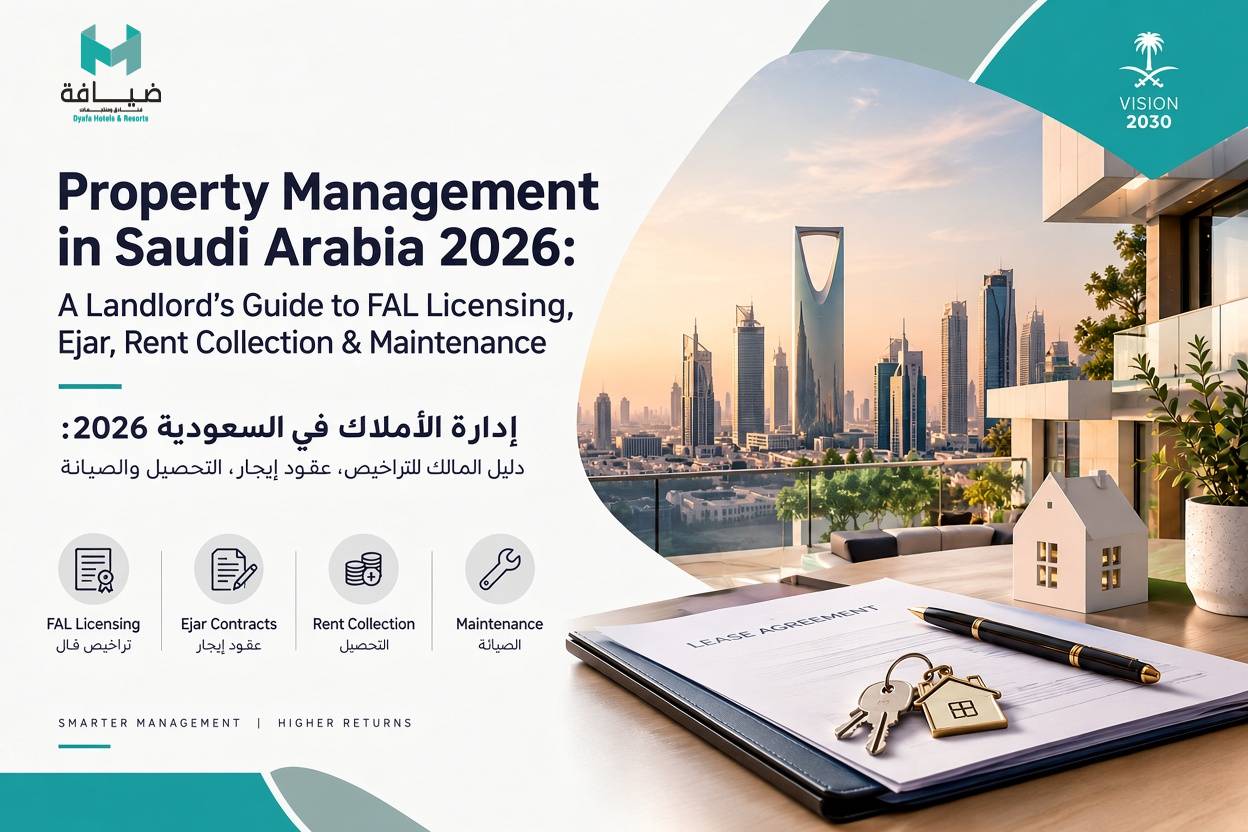

Property management in Saudi Arabia has changed more in the last three years than in the previous twenty. If you own a flat in Riyadh, a villa in Jeddah, a commercial unit in Dammam, or a block of serviced apartments near the Red Sea, the rules you follow in 2026 are not the rules your father followed. Every lease now runs through Ejar, every broker or property manager needs a FAL license from the Real Estate General Authority (REGA), rent is collected digitally, and tenants expect maintenance to be logged, tracked, and fixed quickly.
This guide explains property management in Saudi Arabia in 2026 in plain English. It covers FAL licensing for property managers, how the Ejar rental platform works, how to collect rent legally and on time, how to run maintenance without losing money, and what Vision 2030 means for landlords over the next five years. Whether you manage one unit yourself or own a portfolio and want to hire a licensed property management company, you will find practical answers here.
Quick answer for landlords
In Saudi Arabia in 2026, a landlord must register every lease on Ejar, use a FAL-licensed broker or property manager if someone else manages the property for a fee, collect rent through documented channels (ideally SADAD or bank transfer linked to the Ejar contract), and respond to maintenance under the terms of the Ejar unified contract. Doing these four things correctly protects your income and gives you legal standing in any dispute.
Three forces reshaped the Saudi rental market. First, the government moved rental contracts from paper to a single national platform, Ejar, and made registration a condition for enforcing a lease. Second, the Real Estate Brokerage Law created a licensing regime, known as FAL, so that anyone who manages, markets, or brokers property for others must be qualified and registered. Third, population growth in Riyadh, Jeddah, and the Eastern Province, driven by Vision 2030 projects and new residents arriving for work, pushed demand for well-managed rental housing to record levels.
The result is a market where professional property management is no longer a luxury. A landlord who still collects cash, keeps a handwritten ledger, and fixes air conditioners when a tenant calls is operating with real legal and financial risk. A landlord who understands FAL, Ejar, digital rent collection, and planned maintenance can earn more, spend less, and sleep better.
“In the old market, a landlord’s biggest asset was the building. In the 2026 market, a landlord’s biggest asset is the system that runs the building: the license, the contract, the payment record, and the maintenance log.”
FAL is the real estate licensing program run by the Real Estate General Authority (REGA). It was introduced under the Real Estate Brokerage Law to regulate everyone who provides real estate services to others, including brokerage, marketing, auctions, and property management. The FAL system issues licenses to individuals and companies, lists them in a public registry, and gives REGA the power to inspect, fine, or suspend operators who break the rules.
If you own property and manage it yourself, for your own account, you do not need a FAL license. The license applies to people who perform real estate activities for others and for a fee. However, the moment you hire someone to manage your units, market them, sign tenants, or collect rent on your behalf, that person or company must hold a valid FAL license for property management. Hiring an unlicensed manager exposes you to disputes you may not be able to enforce and to penalties for the manager that can interrupt your income.
Note: REGA updates FAL requirements regularly, including training hours, exam requirements, and renewal fees. Always check the current rules on the FAL portal before signing a long-term management agreement, and ask the manager how they stay compliant with new circulars.
Ejar is the national electronic rental services network operated under the Ministry of Municipalities and Housing. It provides a unified lease contract, links to Absher and Nafath for identity verification, records the landlord, tenant, and broker on one document, and connects to payment systems so rent can be tracked. A registered Ejar contract has the status of an enforceable instrument, which means a landlord can pursue unpaid rent through the enforcement courts far faster than with a private paper contract.
Rent collection is where most landlords lose money, and not because tenants refuse to pay. They lose money through late payments that are never chased, informal discounts given under pressure, cash that is hard to prove, and renewals that drift for months without a new contract. Digital rent collection in Saudi Arabia fixes all four problems when it is set up properly.
Tip: Riyadh landlords should pay close attention to rent regulation. In late 2025 the government announced a multi-year freeze on residential and commercial rent increases within Riyadh city for existing and new contracts. Any rent change or renewal in the capital must respect these rules, and a licensed property manager should be able to show you exactly how they are applied to your units. Check the latest guidance, because the scope and implementation details may have been updated since this article was written.
Saudi buildings face conditions most property manuals never mention: summer temperatures above 45°C, dust storms, high humidity on the coasts, and air conditioning that runs almost year-round. Property maintenance in Saudi Arabia is therefore a core financial activity, not a side task. A single season of neglected HVAC servicing can cost more than a year of planned maintenance.
Under the Ejar unified contract, the landlord is generally responsible for major and structural repairs, including the building envelope, plumbing mains, electrical supply, elevators, and central cooling systems. The tenant is generally responsible for minor repairs resulting from daily use, and for any damage caused by misuse. The contract can set a threshold value below which the tenant handles repairs. Clear wording here prevents most maintenance disputes.
| Period | Task | Why it matters |
|---|---|---|
| March–April | Full HVAC service, filter and coil cleaning, refrigerant check | Prepares units for peak summer load and avoids emergency callouts in July |
| May | Water tank cleaning and pump inspection | Water demand rises sharply in summer; tank hygiene is a health and legal issue |
| September–October | Roof, drainage, and sealant inspection | Winter rain is rare but intense; blocked drains cause expensive leaks |
| Quarterly | Fire safety, elevator service, exterior lighting, dust filter replacement | Civil Defense compliance and tenant safety |
| At every tenant change | Documented inspection with photos, deep cleaning, repainting as needed | Protects the deposit process and shortens vacancy time |
Reactive maintenance means waiting for something to break. Planned maintenance means servicing on a schedule and replacing parts before they fail. In the Saudi climate, planned maintenance typically costs less over a five-year period, reduces tenant complaints, and extends the life of expensive equipment such as chillers and split units. It also produces a maintenance log, which is valuable evidence if a tenant claims the landlord neglected the property.
A family in north Riyadh inherited a small building with three apartments. For years they collected rent in cash and renewed verbally. In 2026 they face the Riyadh rent regulation, a tenant disputing a deposit deduction, and no written maintenance records. By moving every unit to Ejar, appointing a FAL-licensed manager, and switching to SADAD collection, they gain enforceable contracts, a documented deposit process, and a clear position on permitted rent levels.
Furnished units near the Jeddah waterfront attract both long-term tenants and short-stay guests during Umrah seasons and summer holidays. This owner needs a manager who understands the difference between Ejar residential leases and licensed hospitality operations, who can switch units between models based on demand, and who can maintain hotel-grade cleanliness and HVAC performance in a humid coastal climate.
A compound near Dammam houses employees of industrial companies on corporate leases. Here the priorities are bulk Ejar contracting with a corporate tenant, strict preventive maintenance to meet company safety standards, and detailed reporting that the corporate tenant’s procurement team will accept.
Owners of serviced apartments, aparthotels, and resort residences in destinations like the Red Sea, AlUla, or Qiddiya need a partner that combines property management with hospitality operations: revenue management, guest services, brand standards, and asset maintenance to tourism-grade specifications. This is the segment where Dyafa Hotels & Resorts operates, managing hospitality assets for owners who want their property run to hotel standards while remaining fully compliant with Saudi regulations.
| Factor | Self-management | FAL-licensed property manager | Hospitality operator (e.g. Dyafa) |
|---|---|---|---|
| Best for | 1–2 units, owner lives nearby | Residential and commercial portfolios on long leases | Serviced apartments, aparthotels, resort residences |
| Ejar handling | Owner registers each contract | Manager registers and renews under FAL license | Combines Ejar leases with tourism licensing as needed |
| Rent collection | Manual, often cash or transfer | SADAD/bank, automated reminders, arrears follow-up | Dynamic pricing, booking channels, long-stay contracts |
| Maintenance | Reactive, owner finds contractors | Planned schedule, vetted contractors, logs | Hotel-grade preventive maintenance and housekeeping |
| Typical cost | Owner’s time plus repair costs | Percentage of collected rent or fixed fee | Management fee plus performance share |
| Main risk | Compliance gaps and lost income | Quality varies; verify the license | Requires suitable asset and location |
Vision 2030 set a target of 70 percent home ownership and a tourism goal of 150 million visits a year. Both targets reshape property management. Here is what landlords should expect through 2030.
Insight: The landlords who perform best in Saudi Arabia between 2026 and 2030 will not be those with the lowest costs or the highest rents. They will be those with the best data: accurate occupancy, documented maintenance, and clean payment records, all stored in systems that regulators and tenants trust.
Yes. Residential and commercial leases should be registered on Ejar. An unregistered lease is difficult to enforce, and tenants need a registered contract to access many government services, so registration protects both sides.
A FAL license is issued by the Real Estate General Authority (REGA) to individuals and companies that provide real estate services, including property management, for others. Any manager who markets your property, signs tenants, or collects rent on your behalf must hold a valid FAL license covering property management.
Fees are usually a percentage of collected rent for residential and commercial portfolios, or a fixed fee per unit. Hospitality operators managing serviced apartments typically charge a base management fee plus a share of operating profit. Always compare the fee against the services included, especially maintenance supervision and Ejar handling.
If the lease is registered on Ejar, the landlord can apply to the enforcement court directly, because the Ejar contract is treated as an enforceable instrument. This is far faster than proving the debt through a standard lawsuit based on a paper contract.
Under the Ejar unified contract, the landlord generally covers major and structural repairs while the tenant covers minor repairs from daily use and any damage caused by misuse. The contract can specify a value threshold, so read and set this clause carefully.
Riyadh is currently subject to a multi-year rent regulation announced in 2025 that restricts increases on residential and commercial leases within the city. Check the current rules before any renewal and ask your licensed manager to document how the regulation applies to your unit.
A property manager handles long-term leases, rent collection, and maintenance for residential and commercial assets. A hospitality operator such as Dyafa Hotels & Resorts runs serviced apartments, aparthotels, and resort residences with guest services, revenue management, and hotel-grade maintenance, in addition to regulatory compliance.
Service all air conditioning systems in March or April, clean water tanks in May, check roof drainage before the winter rains, and keep a written maintenance log. Planned maintenance in spring prevents the costly emergency callouts that peak in July and August.
Property management in Saudi Arabia in 2026 rests on four pillars: a FAL-licensed manager if anyone acts on your behalf, Ejar registration for every lease, documented digital rent collection, and planned maintenance built for the Saudi climate. Landlords who put these pillars in place earn more predictable income, win disputes faster, keep tenants longer, and protect the long-term value of their assets. Landlords who ignore them are competing against institutional players and giga-project developers with one hand tied behind their back.
Vision 2030 is making the Kingdom one of the most dynamic real estate and tourism markets in the world. The opportunity for landlords is enormous, but it rewards professionalism. Whether you own a single apartment in Riyadh, a portfolio in Jeddah, or a hospitality asset in a new destination, the right management system, and the right partner, will decide how much of that opportunity you capture.
Own a hospitality property in Saudi Arabia?
Dyafa Hotels & Resorts manages serviced apartments, aparthotels, and resort residences for owners who want hotel-standard operations, full regulatory compliance, and transparent reporting.
Talk to Dyafa about managing your propertyTags: property management Saudi Arabia, property management in Saudi Arabia 2026, FAL license Saudi Arabia, FAL license property management, REGA FAL licensing, Ejar rental platform, Ejar contract registration, Ejar unified lease contract, rent collection Saudi Arabia, digital rent collection SADAD, property maintenance Saudi Arabia, HVAC maintenance Saudi Arabia, Riyadh rent freeze 2025, landlord guide Saudi Arabia, how to verify FAL license, how to register a lease on Ejar, how to collect unpaid rent in Saudi Arabia, who pays for maintenance landlord or tenant Saudi Arabia, property management fees Saudi Arabia, serviced apartment management Saudi Arabia, hospitality property management, Vision 2030 real estate, Saudi rental market 2026, Dyafa Hotels and Resorts, dyafa.com



© Copyright 2024 Dyafa - All Rights Reserved | Created By Fandaqah Information Technology