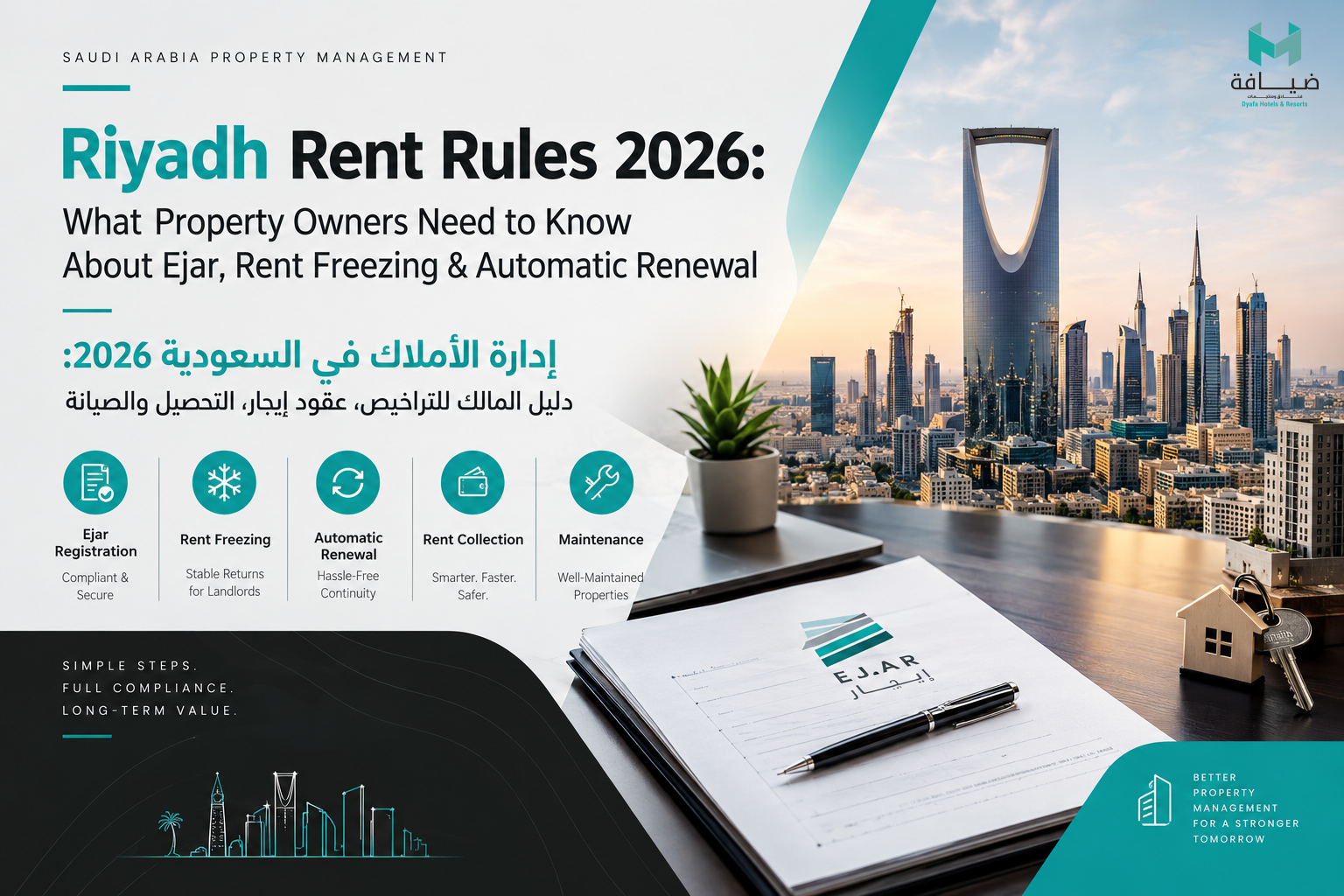

If you own residential or commercial property in Riyadh, the Riyadh rent rules 2026 affect every decision you make: how much you can charge, when a contract renews, how you end a tenancy, and how you prove any of it. In late 2025, the Saudi government announced a five-year rent freeze in Riyadh covering residential and commercial units within the city, paired with mandatory Ejar registration and clear rules on automatic lease renewal. For many landlords this was the biggest regulatory shift in a generation.
This guide explains the Riyadh rental regulations in plain English. You will learn what the rent freeze actually covers, how Ejar contracts and automatic renewal work in practice, what landlords can and cannot do at renewal, how to stay compliant without losing income, and how the rules connect to the wider Vision 2030 housing agenda. Whether you own one apartment in Al Malqa or a commercial building on King Fahd Road, this is the practical overview you need before your next contract.
Quick answer for Riyadh property owners
Rents for residential and commercial properties inside Riyadh city are frozen at their September 2025 levels for five years. Rent increases on renewal are not allowed during the freeze, new contracts cannot exceed the last registered rent for the same unit, every lease must be registered on Ejar, and registered contracts renew automatically on the same terms unless one party gives notice within the period set by the contract and the regulations. Always check the latest guidance from the Real Estate General Authority (REGA) and Ejar, because implementation rules continue to evolve.
Between 2021 and 2025, Riyadh rents rose faster than anywhere else in the Kingdom. The capital attracted regional headquarters under the RHQ program, hundreds of thousands of new residents, and major events and projects. Demand outpaced supply, and annual residential rent increases of 15 to 25 percent became common in popular districts. Households, small businesses, and new arrivals felt the pressure, and the government responded with a package of measures: a rent freeze, acceleration of housing supply, enforcement of white land fees on undeveloped plots, and a push to register every contract on Ejar so the market could be monitored accurately.
For landlords, the key point is that the freeze is one part of a larger policy aimed at stabilising the market, not a stand-alone penalty. It arrived alongside measures to increase supply, which over time are intended to bring balance back to the sector. Understanding this context helps owners plan with a longer horizon rather than reacting to a single headline.
“A rent freeze changes where a landlord’s return comes from. In a rising market, the return came from annual increases. In a regulated market, the return comes from occupancy, efficient operations, and tenants who stay.”
The freeze applies to the rent itself. It does not freeze the cost of utilities, service charges that are genuinely passed through at cost, or fees for optional extras agreed separately in the Ejar contract. It also does not apply outside the Riyadh city boundary; properties in other cities and regions follow the general Ejar and REGA rules without a price cap. Owners with portfolios across the Kingdom therefore need to manage Riyadh units differently from the rest.
Note: Attempting to bypass the freeze through side agreements, unregistered payments, or disguised fees is a violation that REGA can penalise, and it leaves the landlord with no enforceable record of the extra amount. The frozen Ejar rent is also the amount the enforcement court will recognise if a tenant falls behind, so under-declaring rent to appear compliant works against the owner as well.
Ejar is the national electronic rental platform operated under the Ministry of Municipalities and Housing. Under the Riyadh rent rules 2026, Ejar is not just a record-keeping tool; it is the mechanism that defines the legal rent for each unit. The rent recorded on the last registered contract becomes the reference point for the freeze. A landlord who never registered contracts before 2025 has no recorded baseline and will have the rent for the unit determined by REGA’s valuation mechanism rather than by their own past agreements.
A registered Ejar contract is an enforceable instrument. If a tenant stops paying, the landlord can take the contract directly to the enforcement court without first proving the debt in a separate lawsuit. The platform also records payment history, which protects both parties when there is a dispute about what was paid and when. In a frozen market where landlords cannot raise rents to compensate for bad tenants, fast and reliable enforcement is one of the most valuable protections an owner has.
Under the Ejar unified contract and the Riyadh regulations, a lease that reaches its end date renews automatically on the same terms, including the same rent, unless one of the parties gives notice of non-renewal within the required period. This reverses the old practice in which contracts simply lapsed and tenants waited anxiously to learn the new price. For landlords, it means planning has to happen earlier and be documented through the platform.
The Ejar contract specifies the notice period for non-renewal, commonly 60 days before the contract end date, though parties may agree on a longer period. During the Riyadh freeze, a landlord’s ability to decline renewal is tied to legitimate grounds rather than a desire to re-let at a higher price, since re-letting at a higher price is not permitted anyway. Grounds that are generally recognised include the owner needing the property for personal or family use, substantial redevelopment or demolition with the necessary permits, or tenant breaches such as repeated non-payment or misuse of the property. Notice must be given through the platform so there is a timestamped record.
| Timing | Action | Why it matters |
|---|---|---|
| 120 days before expiry | Review the tenant’s payment record and the unit’s condition; decide whether to renew | Leaves time to act before the notice deadline |
| 90 days before expiry | Discuss renewal with the tenant; confirm rent stays at the registered level | Avoids misunderstandings and keeps good tenants |
| By the notice deadline (often 60 days) | If not renewing on valid grounds, submit notice through Ejar | Missing the deadline triggers automatic renewal |
| 30 days before expiry | Confirm the renewal contract on Ejar; schedule any agreed maintenance | Keeps the record continuous and enforceable |
| Expiry date | Renewed contract takes effect automatically on the same terms | No gap in coverage or payment obligations |
It is natural to see a rent freeze only as a constraint, but owners who adapt quickly find real advantages in the new framework.
The tenant has rented since 2022 at a rent well below the current market. Under the freeze, the owner cannot raise it on renewal, and the contract renews automatically each year. The practical response is to focus on costs: schedule preventive HVAC maintenance, review service contracts, and make sure the Ejar contract clearly allocates minor repairs to the tenant. A reliable tenant on a frozen rent is still more profitable than two months of vacancy and refurbishment.
These units have no Ejar history, so their rents are set according to REGA’s mechanism for new units. The investor should document comparable registered rents in the district, price realistically, and register every first contract promptly, because those first registered rents become the baseline for the rest of the freeze period.
A retail tenant’s five-year lease ends in 2026. The landlord hoped to re-let at a higher rate to a new brand. Under the freeze, the rent for the unit cannot exceed the last registered amount, so the strategy shifts to tenant quality, lease length, and fit-out terms. Negotiating a longer term with a strong covenant tenant delivers more value than chasing an increase that is not permitted.
Furnished and serviced units raise a specific question: are they residential leases under Ejar, or licensed hospitality accommodation under the Ministry of Tourism? The answer depends on how the units are licensed and operated. Owners in this segment need an operator that understands both regimes and can structure the asset correctly. This is the space where Dyafa Hotels & Resorts works, managing hospitality assets for owners who want hotel-standard operations with full regulatory compliance, including clear separation between tourism-licensed stays and Ejar-registered tenancies.
| Aspect | Before September 2025 | Under the Riyadh rent rules 2026 |
|---|---|---|
| Rent increases | Negotiated freely at each renewal; double-digit rises common | Not permitted during the five-year freeze |
| New tenant pricing | Set by the owner based on market demand | Capped at the unit’s last registered Ejar rent |
| Contract expiry | Contract lapsed; renewal uncertain | Automatic renewal on the same terms unless notice is given |
| Ejar registration | Required but unevenly enforced | Mandatory; defines the legal rent for each unit |
| Ending a tenancy | Owner could decline renewal to re-let at a higher price | Non-renewal tied to recognised grounds and formal notice |
| Landlord’s source of return | Rental growth | Occupancy, cost control, tenant retention |
Tip: Keep a single compliance file for each Riyadh unit containing the Ejar contract, payment records, maintenance log, and any renewal or non-renewal notices. If REGA inspects, a tenant disputes, or a buyer conducts due diligence, that file answers every question in minutes and demonstrates that the rent and renewal history follow the rules.
The freeze is scheduled to run for five years, but what happens around it will shape the market just as much. Vision 2030 targets 70 percent home ownership and positions Riyadh as a global business and events hub. Several trends are already visible.
Insight: The landlords who will be strongest when the freeze ends are those using these five years to upgrade their buildings, their records, and their tenant relationships. A well-maintained, fully documented, fully occupied asset will command the best terms in any future market.
No. Under the five-year freeze announced in September 2025, rents for residential and commercial properties within Riyadh city cannot be increased on renewal, and new contracts cannot exceed the unit’s last registered Ejar rent.
Yes. The freeze covers both residential and commercial units inside the Riyadh urban boundary, including shops, offices, and showrooms.
An unregistered lease is difficult to enforce and may expose the landlord to penalties. It also leaves the unit without a recorded rent baseline, so the permitted rent would be determined by REGA’s mechanism rather than by the owner’s previous agreements.
When an Ejar contract reaches its end date, it renews automatically on the same terms, including the same rent, unless the landlord or tenant gives notice of non-renewal within the period stated in the contract, commonly 60 days before expiry.
A landlord can decline renewal on recognised grounds, such as needing the property for personal use, approved redevelopment, or tenant breaches like non-payment, provided notice is given through Ejar within the required period. Declining renewal simply to re-let at a higher rent is not an available route during the freeze.
New units are priced according to the mechanism established by the Real Estate General Authority, which considers comparable registered rents in the area. Once the first contract is registered, that rent becomes the unit’s baseline for the freeze period.
It depends on how they are licensed and operated. Units leased to tenants under Ejar residential contracts fall under the freeze. Units operated as licensed tourist accommodation follow Ministry of Tourism rules instead. Owners should get professional advice on structuring, and operators such as Dyafa Hotels & Resorts specialise in running hospitality assets compliantly.
The Real Estate General Authority (REGA) and the Ejar platform publish official guidance and updates. Because implementation details can change, verify the current rules there or through a FAL-licensed property manager before making decisions.
The Riyadh rent rules 2026 rest on three pillars: a five-year rent freeze, mandatory Ejar registration, and automatic renewal of registered contracts. Together they shift the landlord’s focus from chasing rental growth to protecting occupancy, controlling costs, and keeping clean records. Owners who embrace that shift will find the regulated market more predictable than the volatile one it replaced, with stronger enforcement, lower turnover, and clearer rules for everyone involved.
Riyadh remains the centre of Saudi Arabia’s Vision 2030 transformation, with population, investment, and demand for quality accommodation all still rising. The freeze does not change that trajectory; it changes how landlords participate in it. Register every contract, respect the frozen rent, manage renewals on time, maintain your asset well, and work with licensed professionals. Do these consistently, and your Riyadh property will be well positioned both during the freeze and when the market enters its next phase.
Own serviced apartments or hospitality property in Riyadh?
Dyafa Hotels & Resorts manages serviced apartments, aparthotels, and hospitality assets with hotel-standard operations, correct licensing, and transparent owner reporting across the Kingdom.
Talk to Dyafa about your propertyTags: Riyadh rent rules 2026, Riyadh rent freeze, Riyadh rent freeze 5 years, Ejar registration Riyadh, Ejar contract automatic renewal, automatic lease renewal Saudi Arabia, Riyadh rental regulations, rent increase ban Riyadh, REGA rent rules, Ejar unified contract, can landlords raise rent in Riyadh 2026, how automatic renewal works on Ejar, non-renewal notice period Ejar, rent cap new contracts Riyadh, commercial rent freeze Riyadh, Saudi landlord guide 2026, Riyadh property owners, Vision 2030 housing Riyadh, white land fees Riyadh, serviced apartments Riyadh regulations, FAL licensed property manager, Dyafa Hotels and Resorts, dyafa.com



© Copyright 2024 Dyafa - All Rights Reserved | Created By Fandaqah Information Technology