
Published by Dyafa Hotels & Resorts · Al Khobar, Saudi Arabia · Reading time: about 12 minutes
Quick Answer
Hotel technology in Saudi Arabia is reshaping every step of the guest journey: guests now discover hotels through AI-powered search and social platforms, book through mobile apps and instant payment systems, check in with digital ID and mobile keys, and personalise their stay through smart rooms and Arabic-language chatbots. For Saudi hotel owners, the result is faster service, lower operating costs, richer guest data and a stronger position ahead of Vision 2030 tourism targets.
Ten years ago, a typical hotel stay in Riyadh, Jeddah or Al Khobar began with a phone call to a travel agent and ended with a paper bill slipped under the door. Today, the Saudi hotel guest journey starts weeks earlier on a smartphone screen and continues long after checkout in the form of reviews, loyalty points and personalised offers.
The Kingdom is now one of the fastest-growing tourism markets in the world. Saudi Arabia reported more than 100 million domestic and international visits in 2023, reaching its original Vision 2030 target seven years early, and the national goal has since been raised to 150 million annual visits by 2030. Mega-projects such as the Red Sea destination, Diriyah, Qiddiya and NEOM, the expansion of Umrah capacity and global events including Expo 2030 in Riyadh and the FIFA World Cup 2034 are pulling millions of new travellers toward Saudi hotels.
These travellers arrive with high digital expectations. Saudi Arabia has one of the highest smartphone penetration rates in the world, and residents are already used to managing government services through Absher, travel through Nusuk, and payments through Mada, Apple Pay and STC Pay. When a guest who does everything on a phone meets a hotel that still relies on paper forms and long front-desk queues, the gap is immediately obvious.
This article explains how digital transformation in Saudi hotels is redesigning the full guest journey, from the first online search to the moment the door unlocks. We share practical use cases from the Saudi market, a comparison of traditional and technology-enabled operations, and a look at what Vision 2030 means for the future of guest experience technology in the Kingdom.
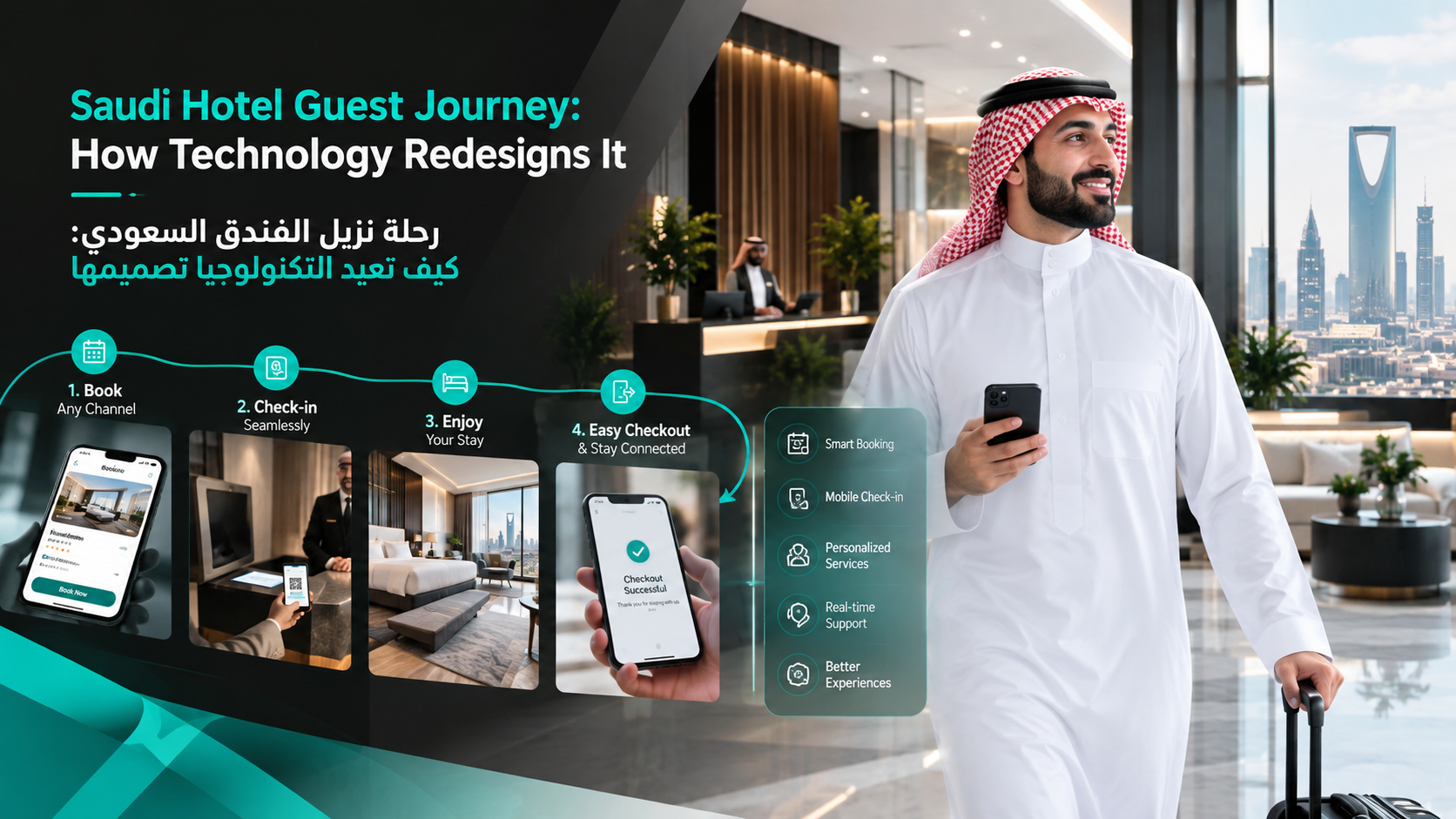
The modern hotel guest journey is best understood as five connected stages. Technology touches each one, but the real value appears when the stages are linked together with shared data, so that what a guest tells the hotel at booking is remembered at check-in and acted on during the stay.
Discovery no longer means only Google. Saudi travellers increasingly search through AI assistants, TikTok and Instagram Reels, Snapchat (which has exceptionally high usage in the Kingdom), and metasearch sites such as Google Hotels. A growing share of travellers ask an AI tool a natural-language question such as "best family hotel near Al Khobar Corniche with a pool" and expect a direct answer.
For hotels, this changes the marketing playbook. Websites need structured data (schema markup), clear Arabic and English content, updated Google Business Profiles and consistent information across booking channels, so that both search engines and generative AI models can understand and recommend the property. This discipline, known as Generative Engine Optimisation (GEO) and Answer Engine Optimisation (AEO), is now as important for a hotel as classic SEO.
Once a guest chooses a hotel, the booking must be effortless. A modern booking engine for the Saudi market should load in under three seconds on mobile, display prices in Saudi riyals with VAT included, support Mada, Apple Pay and major cards, and offer Arabic and English interfaces with correct right-to-left layout. Integration with a channel manager keeps availability accurate across Booking.com, Agoda, Almosafer and direct channels, avoiding the overbookings that damage reputation.
Direct bookings matter financially. Every reservation that arrives through the hotel's own website or WhatsApp channel saves the commission paid to online travel agencies, which typically runs between 15 and 25 percent. Technology such as rate-parity monitoring, loyalty pricing and abandoned-booking reminders helps hotels win this direct business.
The days between booking and arrival are a valuable opportunity. Automated pre-arrival messages can confirm the reservation, collect guest preferences (pillow type, floor level, early check-in), offer upgrades and airport transfers, and complete registration in advance. Because WhatsApp is the dominant messaging channel in Saudi Arabia, hotels that communicate through the WhatsApp Business API see far higher engagement than those relying on email alone.
This is the stage guests remember most, and where contactless check-in in Saudi hotels is spreading fastest. Options range from self-service kiosks in the lobby to full mobile check-in, where the guest verifies identity, signs the registration card digitally and receives a mobile key on their phone. Verification of Saudi national IDs and Iqamas can be integrated with the hotel's property management system (PMS) and with the Ministry of Tourism's mandatory guest reporting platform, turning a five-minute manual process into a few seconds.
Inside the room, smart controls for lighting, air conditioning and curtains, in-room tablets or QR codes for service requests, and Arabic-speaking chatbots handle routine questions around the clock. At departure, express checkout with an e-invoice compliant with ZATCA (Saudi e-invoicing) requirements removes the last queue. After the stay, automated review requests, loyalty programme updates and personalised offers keep the relationship alive.
Key Insight
The most successful Saudi hotels do not think in terms of separate gadgets. They think in terms of one connected data flow: booking engine, PMS, messaging, door locks, payments and loyalty all speaking the same language. A mobile key that does not know the guest asked for a high floor is only half a solution.
Why are owners and operators across the Kingdom investing in smart hotel technology? The benefits fall into two groups: what the guest feels, and what the owner sees on the profit and loss statement.
"Technology in hospitality should be invisible when it works and unforgettable in its results. The guest should not notice the system; they should only notice that everything simply happened on time." — Operations perspective, Dyafa Hotels & Resorts
The Saudi market is not one market. Riyadh, Jeddah, the Eastern Province, Makkah and Madinah, and the new giga-project destinations each have different guest profiles. Here is how hotel digital transformation plays out in each.
Corporate travellers to Riyadh's King Abdullah Financial District or to Al Khobar, Dammam and Jubail in the Eastern Province value speed above all. Hotels serving this segment are adopting mobile check-in, digital corporate billing, fast and secure Wi-Fi, and meeting-room booking through apps. For Dyafa Hotels & Resorts, headquartered in Al Khobar, the Eastern Province's mix of energy-sector business travel and weekend leisure from Bahrain and Riyadh makes flexible, technology-led operations essential rather than optional.
Religious tourism involves very large groups, tight schedules and guests from dozens of countries speaking many languages. Technology solves real pain points here: bulk digital check-in for tour groups, multilingual chatbots, integration with the Nusuk platform for pilgrim journeys, prayer-time alerts, and real-time shuttle tracking to the Haram. Digital hotel experiences for Umrah pilgrims reduce lobby congestion at peak times, which is both a comfort and a safety benefit.
Family travellers plan around children, privacy and activities. Smart family rooms, in-app activity booking, digital access to pools and beaches, and personalised recommendations based on stay history are transforming the leisure segment. New Red Sea destinations are built as technology-native resorts where the guest app is the primary interface for the entire stay.
Domestic tourism is the backbone of Saudi hotel demand. Mid-scale brands, including Dyafa's own Dyafa Inn concept, rely on lean operations. Here the technology priority is efficiency: cloud-based PMS that runs without on-site servers, automated pricing that responds to weekend and holiday demand, WhatsApp-based guest service, and self-service kiosks that allow a small team to manage a busy property with consistent quality.
Riyadh Season, Formula 1 in Jeddah, LIV Golf, Esports World Cup and major exhibitions create sharp demand peaks. Revenue management software, dynamic pricing and integrated distribution allow hotels to capture this value while keeping rates fair and transparent, in line with Ministry of Tourism guidance.
Practical Tip for Hotel Owners
Before buying any new system, map your guest journey on a single page and mark every point where a guest waits, repeats information or fills a form. Each mark is a candidate for technology. Fix the top three first, measure the results for 90 days, then expand. This approach protects budget and keeps staff engaged with the change.
The table below compares how each stage of the guest journey works in a traditional hotel versus a technology-enabled hotel operating in Saudi Arabia today.
| Journey Stage | Traditional Hotel | Technology-Enabled Hotel |
|---|---|---|
| Discovery | Listings on OTAs, printed brochures, word of mouth | Structured website data, AI search visibility, social video, Google Business Profile |
| Booking | Phone, email, heavy OTA dependence | Mobile booking engine, Mada and Apple Pay, channel manager, WhatsApp booking |
| Pre-Arrival | Little or no contact until arrival | Automated WhatsApp messages, digital registration, upsell offers |
| Check-In | Queue, paper card, manual ID copy, plastic key card | Mobile or kiosk check-in, digital ID verification, mobile key, automatic Ministry reporting |
| In-Stay | Phone the front desk, printed menus, manual room controls | Chatbot and app requests, QR menus, smart room controls, energy automation |
| Checkout | Front-desk queue, printed invoice | Express mobile checkout, ZATCA-compliant e-invoice, instant payment |
| Post-Stay | No follow-up | Review requests, loyalty updates, personalised return offers, CRM data |
| Owner Visibility | Monthly paper reports | Real-time dashboards for occupancy, ADR, RevPAR and satisfaction |
Neither column is perfect. The traditional model offers warmth and human contact that many Saudi guests still value deeply. The technology-enabled model offers speed and consistency. The winning approach in the Kingdom combines both: automate the routine so staff can deliver genuine Arabian hospitality where it matters most.
Dyafa Hotels & Resorts is a Saudi hospitality group based in Al Khobar, operating through two complementary arms: Dyafa Operations & Maintenance Company, which manages day-to-day hotel operations, and Aqar Al Dyafa, the group's real-estate arm responsible for hospitality assets. The group also develops its own mid-scale hotel brand, Dyafa Inn.
Because Dyafa combines asset ownership with hotel operation, technology decisions are made with both the owner's return and the guest's experience in mind. In practice this means:
For owners considering a hotel management agreement in Saudi Arabia, this integrated approach means one partner is accountable for both the asset strategy and the guest journey that drives its performance.
Vision 2030 places tourism at the centre of economic diversification, with a target of tourism contributing around 10 percent of GDP and creating more than one million jobs. The National Tourism Strategy, the Tourism Development Fund and the Ministry of Tourism's hotel classification programme all reward properties that deliver high-quality, measurable guest experiences. Here are the trends most likely to shape the future of hotel technology in Saudi Arabia over the next five years.
AI assistants will move from answering questions to completing tasks: booking a room, arranging a car, changing a reservation. Hotels whose systems expose clean data and secure booking APIs will be the ones AI agents can actually transact with. Arabic-language AI models trained on Saudi dialects will make this natural for domestic guests.
As the Kingdom's digital identity infrastructure matures, check-in verification through national digital ID is likely to become standard, removing the need to photocopy documents and making guest reporting to authorities instantaneous and accurate.
Saudi Green Initiative goals are pushing hotels toward smart energy and water management. Occupancy-linked cooling, smart water monitoring and digital housekeeping schedules reduce both cost and carbon, and increasingly influence corporate booking decisions.
Guests want hotels to remember them, but the Personal Data Protection Law requires care. Expect consent-based preference profiles that follow guests across a brand's properties while giving them full control over their data.
Expo 2030 and the FIFA World Cup 2034 will bring millions of first-time visitors in concentrated periods. Hotels will need technology that scales: bulk digital check-in, multilingual automation, integration with national transport and event ticketing, and robust cybersecurity.
Note
Technology adoption in Saudi hospitality is moving quickly, and regulations such as e-invoicing phases, guest reporting requirements and data protection rules are updated regularly. Hotel owners should confirm current requirements with the Ministry of Tourism and ZATCA before finalising any system design.
The hotel guest journey is the complete sequence of interactions a guest has with a hotel, from first discovering it online, through booking, pre-arrival communication, check-in, the stay itself, checkout and post-stay follow-up. In Saudi Arabia, most of these stages now happen on a smartphone, which is why hotel technology has become central to guest satisfaction.
Guests receive a link, usually by WhatsApp or SMS, before arrival. They verify their identity (national ID, Iqama or passport), sign the registration card digitally and pay or pre-authorise a card. On arrival they receive a mobile key or collect a card from a kiosk, bypassing the front desk. The hotel's system then reports the stay to the Ministry of Tourism platform automatically.
Yes, when implemented correctly. Mobile keys use encrypted Bluetooth or NFC credentials that are tied to a specific device and expire automatically at checkout. They are generally more secure than plastic key cards, which can be lost, copied or left active after a guest departs.
No. Technology replaces repetitive tasks such as data entry, key encoding and routine questions. It frees staff to focus on genuine hospitality, problem-solving and personal service, which remain highly valued in Saudi culture. Vision 2030 also emphasises creating quality hospitality jobs for Saudi nationals, and technology skills are part of that future.
Start with a cloud-based property management system, a mobile-friendly booking engine with Mada and Apple Pay, and WhatsApp Business messaging for guest communication. These three deliver the fastest return. Add mobile check-in, smart room controls and revenue management software as the property grows.
Vision 2030 aims for 150 million annual visits and a much larger tourism contribution to GDP. Technology allows hotels to serve more guests with consistent quality, meet international service standards, provide accurate data to national tourism authorities and operate more sustainably, all of which are direct Vision 2030 priorities.
Publish clear, factual content in Arabic and English, use schema markup for hotel, room, price and FAQ data, keep your Google Business Profile complete, encourage authentic reviews and ensure information is consistent across every platform. AI models favour sources that are structured, accurate and regularly updated.
Yes. Through Dyafa Operations & Maintenance Company, the group manages hotel operations and pre-opening for owners across Saudi Arabia, combining local market knowledge with a technology-enabled operating framework. Owners can contact the team at [email protected] or visit dyafa.com.
From the first search on a phone to the moment the door unlocks, technology is redesigning the Saudi hotel guest journey at every stage. AI-driven discovery, mobile-first booking, WhatsApp pre-arrival communication, contactless check-in with digital ID, smart rooms and express checkout are no longer futuristic ideas; they are the expectations of a young, connected Saudi population and the millions of international visitors arriving for Umrah, business, leisure and global events.
For hotel owners and operators, the message is clear. Hotel technology in Saudi Arabia is not a cost centre but a growth engine: it increases direct revenue, reduces operating costs, ensures compliance and produces the data needed to make better decisions. Most importantly, it gives hospitality teams the time to do what Saudi hospitality has always done best, which is to make every guest feel welcomed and honoured.
As Vision 2030 accelerates toward 2030, 2034 and beyond, the hotels that connect their systems, put Arabic-speaking guests first and design their operations around a seamless digital journey will define the next chapter of Saudi hospitality.
Dyafa Hotels & Resorts partners with owners across Saudi Arabia to operate, open and optimise hotels with a technology-enabled, guest-first approach. Let's discuss how your property can be ready for the next wave of Saudi tourism.
Email: [email protected] · Phone: 9200 6655 · 2876 Prince Turki Road, Al Khobar 34611, Saudi Arabia
Tags
hotel technology in Saudi Arabia, Saudi hotel guest journey, contactless check-in Saudi hotels, mobile check-in hotels Saudi Arabia, digital transformation in Saudi hotels, smart hotel technology, guest experience technology, hotel AI chatbot Arabic, mobile key hotel Saudi Arabia, hotel booking engine Saudi Arabia, Vision 2030 tourism technology, hotel management company Saudi Arabia, Dyafa Hotels and Resorts, Dyafa Inn, hotel operations Al Khobar, Eastern Province hotels, digital hotel experience for Umrah pilgrims, AI concierge hotels Riyadh Jeddah, how technology is changing the Saudi hotel guest journey, best contactless check-in solutions for hotels in Saudi Arabia, hotel PMS cloud Saudi Arabia, WhatsApp hotel guest messaging, ZATCA e-invoicing hotels, Saudi hospitality industry trends 2026



© Copyright 2024 Dyafa - All Rights Reserved | Created By Fandaqah Information Technology