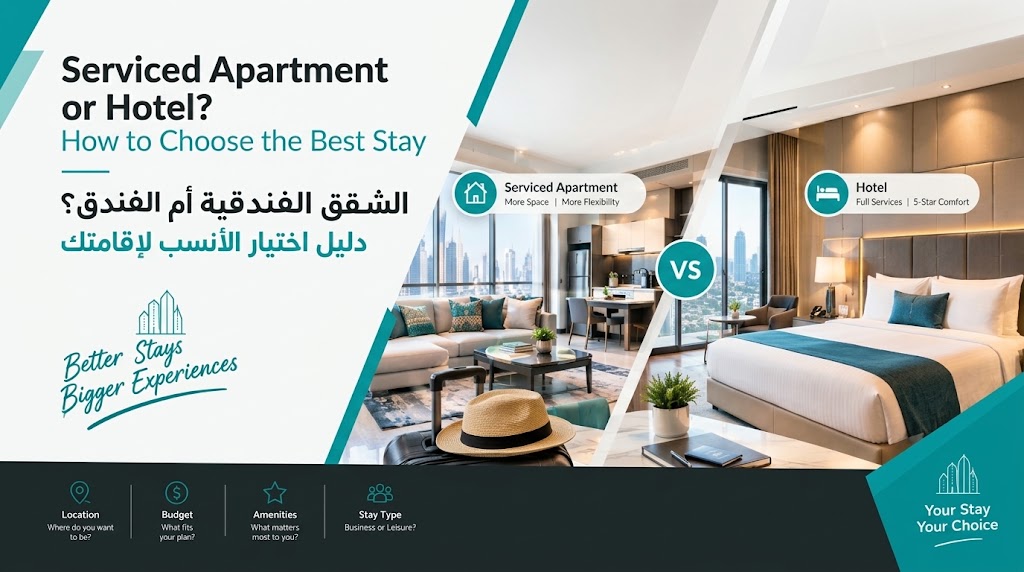

Quick answer: Choose a serviced apartment if you are travelling with family, staying longer than three nights, or you need a kitchen, separate bedrooms, and a lower cost per person. Choose a hotel if your trip is short and intense, you want full daily service, or you need a central location with restaurants, meeting rooms, and a gym on site. The real question is not which one is better overall, but which one matches the trip you are actually taking.
Travel inside the Kingdom has changed. Between the growth of domestic tourism, packed event seasons, major projects hiring teams for months at a time, and millions of visitors arriving for Umrah and Hajj, the question of serviced apartment or hotel now comes up before almost every booking. The traveller today is not just looking for a bed. They are looking for a place that fits how they live for the next few nights.
Most comparisons stop at one sentence: apartments are cheaper, hotels have better service. That is too shallow to book on. The real difference between serviced apartments and hotels shows up in practical details: how many nights you are staying, how many people are with you, whether you need to cook, how your day is structured, and which city and season you are travelling in. Change any one of those and the right answer changes with it.
This guide from Dyafa (dyafa.com) puts both options side by side: a clear definition of each, a full comparison table, a realistic cost breakdown with numbers, use cases drawn from the booking patterns we see across Saudi cities, and a short checklist that settles the decision in about two minutes. By the end, you should know exactly what to book and why.
A serviced apartment (also called a hotel apartment or aparthotel) is a fully furnished residential unit operated to hotel standards under a valid licence. You get the independence of a home combined with the support of a hotel: check-in, housekeeping, maintenance, security, internet, and utilities included. What you also get, and a hotel room does not offer, is a kitchen, a living room, and usually a washing machine.
Important note: a serviced apartment is not the same thing as a plain furnished apartment. A serviced apartment is a licensed hospitality property with operating, safety, and cleanliness standards, professional management, and clear contractual responsibility. A furnished flat rented privately may have none of those. Always confirm the licence and the official invoice before you pay.
A hotel is built around a single unit — the room — and a single promise: everything is done for you. Daily housekeeping, breakfast service, on-site restaurants, room service, a concierge, meeting and event space, and a fitness centre in higher-rated properties. You arrive with a suitcase and nothing else is your problem.
The real strength of a hotel is readiness and location. Hotels tend to sit in central business districts, near airports, and next to exhibition and event venues, which makes them the logical choice for short, high-pressure trips. The weakness appears when the group grows or the stay stretches. One room becomes tight, a second room doubles the rate, and every extra service — meals, laundry, minibar — lands on the final bill.
This table covers the criteria that genuinely affect your stay. Use it as a quick reference before you confirm a booking.
| Criteria | Serviced Apartment | Hotel |
|---|---|---|
| Space | Large — bedrooms plus a living room | Limited to one room |
| Kitchen | Included and fitted | Usually none |
| Privacy | High — separate rooms with doors | Moderate — shared single space |
| Housekeeping | Scheduled or on request | Daily and comprehensive |
| Food and dining | Cook yourself or order in | On-site restaurants and room service |
| Cost per person | Falls as the group grows | Rises quickly with extra rooms |
| Long stays | Ideal — weekly and monthly rates | Expensive and tiring |
| Short stays | Fine, but benefits go unused | Best and fastest option |
| Business facilities | Basic — desk and internet | Meeting rooms and event space |
| Best suited to | Families, groups, extended stays | Short business trips and couples |
The advantages of serviced apartments in Saudi Arabia go well beyond extra square metres. They are financial, practical, and personal.
The pattern we see at Dyafa is simple: every extra night and every extra guest pushes the decision toward a serviced apartment, while every hour of time pressure and every formal meeting pushes it back toward a hotel.
Comparing serviced apartment prices with hotel rates using the nightly figure alone is misleading. A fair comparison includes accommodation, food, and laundry. The example below is illustrative, based on a family of five staying seven nights in a major Saudi city.
| Cost item | Hotel (2 rooms) | Serviced apartment (3 bedrooms) |
|---|---|---|
| Accommodation, 7 nights | SAR 6,300 | SAR 4,900 |
| Meals for five people | SAR 1,750 | SAR 840 |
| Laundry | SAR 300 | Included (in-unit machine) |
| Estimated total | SAR 8,350 | SAR 5,740 |
Note on the numbers: these figures are estimates for illustration only and will change with the city, the season, the property standard, and applicable taxes and fees. The takeaway is not the exact total but the shape of the gap. In scenarios like this one, the difference can reach roughly a third of the budget — often enough to extend the trip by two extra nights.
Saudi families are frequently larger than a single hotel room allows, and they usually need a kitchen for the children and a space to receive relatives. This is where hotel apartments in Riyadh or family accommodation in Jeddah win clearly, especially during school holidays. The preferred setup is a two or three bedroom unit close to a mall, a mosque, and a park.
If you are flying in for one or two nights for a meeting in King Abdullah Financial District or an industrial site in Dammam, a hotel saves time and energy: it is close to the venue, breakfast is quick, and a meeting room is available on demand. The kitchen and living room of an apartment would sit unused.
With large-scale projects running across the Kingdom, demand for extended stay apartments has grown sharply. For stays of weeks or months, an apartment is an operational necessity rather than a luxury: a kitchen reduces the team's food spend, laundry is handled in-unit, and weekly or monthly agreements cost far less than daily hotel rates. It is also the standard choice for new hires waiting on permanent housing.
In Makkah and Madinah, proximity to the Haram is the deciding factor. For large families or groups travelling with elderly relatives, serviced apartments near the Haram for Umrah with family offer real relief: multiple bedrooms so people can rest in rotation between prayers, and a kitchen for light meals that fit a demanding schedule. For a short solo visit, a hotel next to the Haram remains the fastest option.
Families accompanying a patient often need accommodation near a hospital for an open-ended period, plus a kitchen for prescribed diets. A serviced apartment eases both the financial and emotional pressure, and gives the patient quiet and privacy that a small hotel room cannot.
During Riyadh Season, large exhibitions, and international sporting events, room rates climb and connecting rooms disappear. Serviced apartments become the smart alternative for groups of friends and colleagues: the cost spreads across more people, and everyone stays together instead of being scattered across different floors.
Training programmes that run for several weeks, and remote work from another city, suit the apartment model well: stable internet, a proper desk, and full control over daily spending.
Answer these honestly. If most of your answers point one way, your decision is made.
Working with booking requests every day at Dyafa (dyafa.com), three patterns repeat often enough to be worth naming.
What Dyafa does differently: honest unit descriptions instead of flattering photography, every fee disclosed before payment, side-by-side options matched to your group size and length of stay, and a team that helps you pick the right size rather than always selling the largest. Our aim is that you pay for what you will actually use.
Saudi Arabia's accommodation sector is being reshaped by Vision 2030, which positions tourism as a pillar of the non-oil economy and sets ambitious announced targets for annual visits by 2030. That shift is changing the choices in front of every traveller in five visible ways.
The likely outcome is that "apartment or hotel?" will stop being a binary question. It will become a sharper one: what level of service does this particular trip need? That framing is more accurate, and fairer to both options.
A serviced apartment is a complete residential unit with one or more bedrooms, a living room, and a kitchen, supported by hotel-style services. A hotel is built around a single room with full daily service and on-site facilities such as restaurants and meeting rooms. In short, an apartment gives you space and independence; a hotel gives you readiness and service.
Not always on the nightly rate, but usually on total cost once the group is larger or the stay is longer, because you avoid extra rooms, restaurant meals, and laundry charges. For one person staying a single night, a hotel is often the cheaper and more sensible choice.
It depends on the operator. Some provide daily cleaning like a hotel, others clean every second or third day, and some offer it on request for an added fee. Confirm the policy before booking, particularly for a long stay.
For families of four or more, or anyone travelling with young children or elderly relatives, serviced apartments are usually better: separate bedrooms, a kitchen, more privacy, and a lower cost per person. Hotels still suit small families on a short trip built around an outdoor itinerary.
Yes. Most licensed serviced apartments accept single-night bookings, although some properties apply a minimum stay during peak seasons and major events. Check the minimum-stay rule and the cancellation policy when you book.
Very suitable. Any stay beyond a week benefits from the kitchen, in-unit laundry, dedicated workspace, and discounted weekly or monthly rates. These factors lower costs and noticeably improve day-to-day quality of life for an individual traveller or an entire team.
Look for the official property name and licence details, ask for a proper tax invoice showing VAT and any fees, read recent reviews, and confirm there is a clear contact channel with management responsible for cleaning and maintenance. If those are missing, treat it as a warning sign and walk away.
Typically a national ID for citizens, an Iqama for residents, or a passport for visitors, plus a payment card if a deposit applies. Requirements vary by property type and are updated from time to time, so confirm what is needed with the property before you travel.
There is no single correct answer to serviced apartment or hotel, because the best choice is the one closest to the shape of your trip. A hotel buys you time and readiness. A serviced apartment buys you space, privacy, and savings. When the trip is short, focused, and business-driven, book the hotel and do not overthink it. When it is a family trip, a long stay, or one that needs a kitchen and separate bedrooms, a serviced apartment will save you both money and stress.
The rule worth remembering: calculate total cost rather than the nightly rate, measure location in travel time rather than kilometres, and ask about housekeeping, fees, and cancellation before you confirm. Three minutes of the right questions protects an entire trip, and turns a booking into a stay you would happily repeat.
Ready to book the right stay?
Let the Dyafa team match you with the right unit for your group size, length of stay, and budget — with clear pricing and no surprise fees.
Explore stays on dyafa.com
serviced apartment or hotel, serviced apartments in Saudi Arabia, difference between serviced apartments and hotels, hotel apartments in Riyadh, family accommodation in Jeddah, long stay accommodation, extended stay apartments, furnished apartments with kitchen, business travel accommodation Saudi Arabia, serviced apartment prices, best places to stay in Saudi Arabia, Umrah accommodation, Riyadh Season stays, Vision 2030 tourism, Dyafa




© Copyright 2024 Dyafa - All Rights Reserved | Created By Fandaqah Information Technology