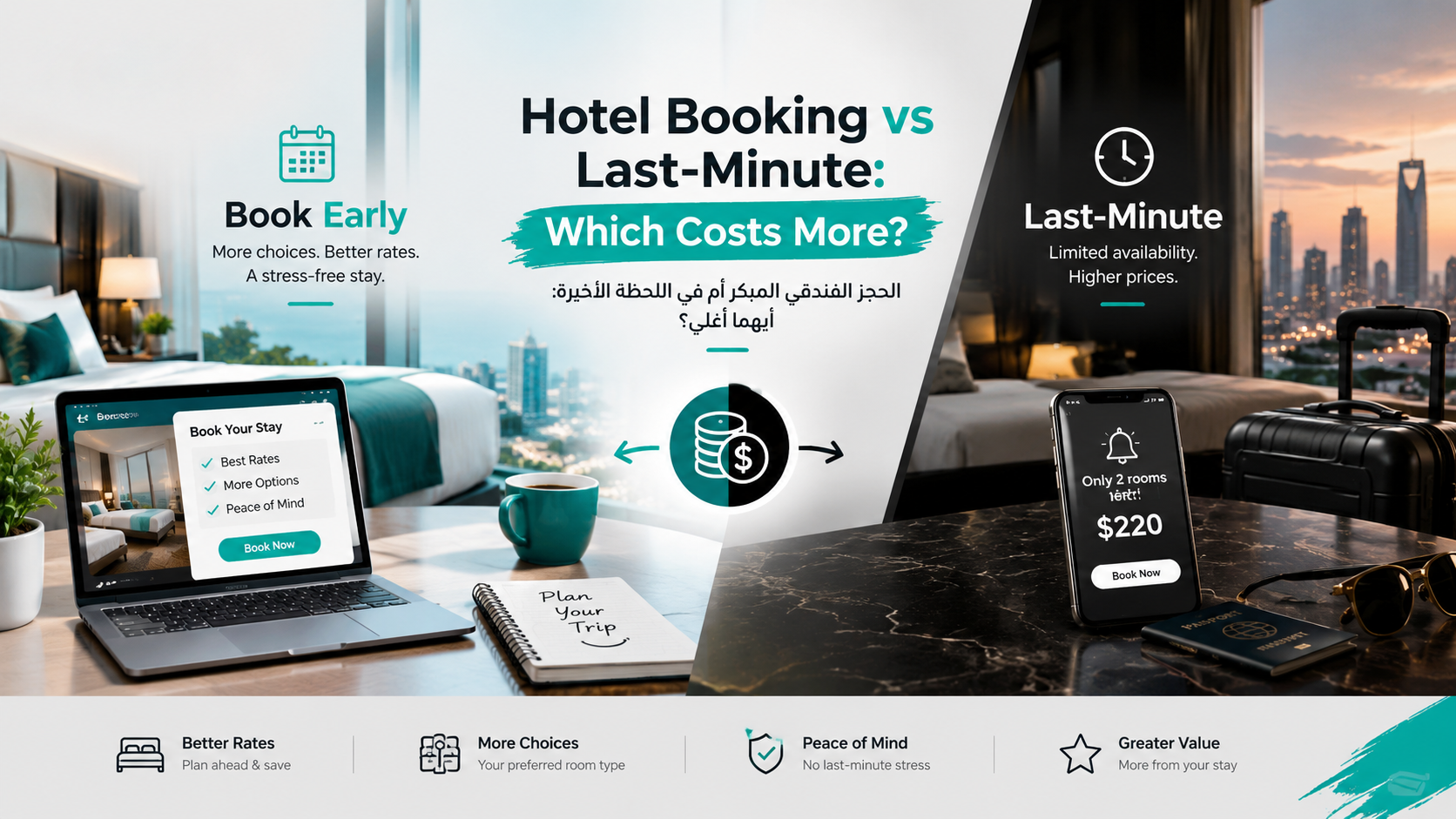

Two guests can stay in the same room, on the same night, in the same city, and pay very different prices. The difference usually comes down to one decision: when they booked. Here is how hotel pricing really works, and how to pick the right moment to book your next stay in Riyadh, Jeddah, Makkah, Al Khobar or anywhere in the Kingdom.
The short answer
In most cases, advance hotel booking costs less than last-minute booking, especially during high-demand periods such as Ramadan, Eid holidays, Riyadh Season, national holidays and major events. Last-minute booking is cheaper only when demand is low and a hotel still has many unsold rooms, for example mid-week during a quiet month. In Saudi Arabia, where the event calendar drives demand, booking early with a flexible rate is usually the safest way to pay less.
Travel inside Saudi Arabia has changed fast. Families now plan weekend escapes to the Eastern Province, business travellers fly into Riyadh for conferences almost every month, pilgrims arrive for Umrah all year, and entertainment seasons fill hotels in cities that used to be quiet. More travel means more competition for the same rooms, and that competition shows up directly in the price you pay.
Many travellers still believe a myth: that hotels "dump" empty rooms at the last minute, so waiting always pays. Sometimes that is true. Often it is not. And in the Saudi market, where demand can double around a single event weekend, waiting can be the most expensive choice you make.
This guide explains how hotel prices in Saudi Arabia are set, when advance hotel booking saves money, when last-minute hotel deals are real, and a simple strategy you can use every time you book.
Hotel rooms are a perishable product. A room that stays empty tonight can never be sold again. That is why almost every modern hotel uses dynamic hotel pricing, also called revenue management. Instead of one fixed price, the rate changes based on how many people want to stay on a given night.
When a hotel is filling up, the remaining rooms become more valuable, so the rate goes up. When a hotel is mostly empty close to the date, the rate may come down to attract guests. This single rule explains most of what you see when you search for rooms.
Hotels track how fast bookings arrive for each future date and compare that pace with previous years. If bookings for a weekend in February are arriving faster than usual, prices rise early, sometimes weeks before you start looking.
A concert, a sports final, a global conference or a public holiday can fill every hotel in a city within days of being announced. In Saudi Arabia these peaks are frequent and predictable: Ramadan, the two Eids, Saudi National Day, Founding Day, school holidays, and the growing calendar of entertainment and business events.
Business hotels in Riyadh are often busier Sunday to Wednesday, while leisure destinations and coastal cities such as Al Khobar and Jeddah see more demand on Thursday and Friday nights. Longer stays may also unlock better nightly rates because they fill several nights at once.
Online travel agencies charge hotels a commission on each booking. Hotels therefore often value direct bookings made on their own website, by phone or by email, and may offer extra flexibility or benefits to guests who book the hotel directly.
The cheapest night is not decided by how early or late you book. It is decided by how many other people want the same room on the same night.
"Early" and "late" mean different things to different people. For this guide we use four simple windows, counted from the day you book to your check-in date.
Early
60+ days before
Widest room choice. Best for peak seasons and events.
Advance
21 to 60 days
The sweet spot for most trips in the Kingdom.
Short notice
7 to 20 days
Fine in normal weeks. Risky around holidays.
Last-minute
0 to 6 days
Can be a bargain in quiet periods, costly in busy ones.
For most travellers in Saudi Arabia, booking ahead delivers more than a lower price. Here is what you gain:
Tip: book early, but book flexible
Choose a rate with free cancellation when you book early. If the price drops later, you can cancel and rebook at the lower rate. You lock in availability without giving up the chance to save.
Last-minute booking is not always a mistake. It can work well when these conditions line up:
The hidden cost of waiting
Even when the room rate looks lower at the last minute, the total trip can cost more:
Here is how the two approaches compare across the factors that matter most to travellers in Saudi Arabia.
| Factor | Advance booking | Last-minute booking |
|---|---|---|
| Price in peak season | Usually lower | Usually much higher, or sold out |
| Price in low season | Fair and stable | Can be lower if rooms are unsold |
| Room choice | Full choice, including suites and family rooms | Whatever is left |
| Cancellation terms | Flexible options widely available | Often stricter or non-refundable |
| Risk of no availability | Low | High around events and holidays |
| Planning stress | Low, everything is settled | High, decisions made under pressure |
| Best for | Families, pilgrims, event visitors, groups, fixed dates | Flexible solo travellers on quiet dates |
To show how dynamic hotel pricing behaves, imagine one standard room in a city hotel. On a normal quiet weekend, the rate stays flat or dips as the date approaches. On an event weekend, the rate climbs steadily as rooms sell.
| When you book | Quiet weekend | Event weekend |
|---|---|---|
| 60 days before | SAR 400 | SAR 450 |
| 14 days before | SAR 380 | SAR 650 |
| 2 days before | SAR 340 | SAR 950, or sold out |
Figures are illustrative, created to explain how pricing moves. They are not actual hotel rates. Real prices vary by hotel, city, room type and date.
The lesson is clear. On quiet dates, waiting saved around 15% in this example. On the event weekend, waiting more than doubled the cost. Because most travellers cannot tell in advance which kind of weekend they are facing, booking early with free cancellation protects you in both cases.
The right booking window depends on the season and the city. Use this general guide as a starting point.
| Period or trip type | Demand | Suggested booking window |
|---|---|---|
| Ramadan, especially the last ten nights (Makkah and Madinah) | Very high | 3 to 6 months or more |
| Eid al-Fitr and Eid al-Adha holidays | Very high | 2 to 3 months |
| Riyadh Season and major concerts or sports events | High to very high | As soon as the event date is announced |
| Saudi National Day and Founding Day long weekends | High | 4 to 8 weeks |
| Summer school holidays (Abha, Taif, Al Baha, coastal cities) | High | 6 to 10 weeks |
| Large business conferences in Riyadh | High | As soon as your attendance is confirmed |
| Regular weekend getaway, off-peak | Moderate | 1 to 3 weeks |
| Mid-week stay in a quiet month | Low | Last-minute can work |
Every trip is different. These common scenarios show which booking approach tends to cost less.
A family of five from Dammam plans Umrah in the last ten nights of Ramadan. They need two connecting rooms close to the Haram. This is the clearest case for Umrah hotel booking months in advance. Demand is at its annual peak, suitable family rooms are limited, and waiting risks both higher prices and no suitable rooms at all.
A manager from Jeddah is registered for a major technology conference in Riyadh. Hotels near the venue fill quickly once the event dates are public. The best move is to book the moment attendance is confirmed, preferably with a refundable rate, and ask the hotel about corporate or long-stay rates if colleagues are travelling too.
A couple in Riyadh wants a relaxed Thursday-to-Saturday break by the sea. On an ordinary weekend, booking one to two weeks ahead is usually fine, and a last-minute offer may even appear. On a National Day long weekend or during a school break, the Eastern Province also welcomes visitors from across the Gulf, so booking a month or more ahead is wiser.
Families escaping the summer heat head to Abha, Al Baha and Taif. Room supply in mountain destinations is smaller than in major cities, so the good options sell out early. Advance booking of six to ten weeks is the safer choice.
Sports fans heading to Jeddah for a Formula 1 race weekend, or visitors attending a headline concert during Riyadh Season, compete with thousands of other guests for the same nights. Hotel rates during events can rise sharply as the date nears. Book as soon as you have your ticket.
A freelancer decides on Monday to spend Tuesday and Wednesday nights in a coastal city in a quiet month. This is where last-minute hotel booking can genuinely save money, because hotels with empty rooms may lower their rates close to the date.
You do not have to choose between early and late. Follow these steps in order and you get the benefits of both.
Note: compare the total, not the nightly rate
A slightly higher rate that includes breakfast, free cancellation and parking can cost less overall than a cheaper non-refundable rate with extras added at the front desk. Always compare the final amount for your full stay.
Whether you book early or late, where you book also affects what you get. When you book a hotel directly, you deal with the people who will host you. Special requests reach the right team, changes are handled without a middle party, and questions about your stay get answered by staff who know the property.
Dyafa Hotels & Resorts is a Saudi hospitality group headquartered in Al Khobar, operating hotels under the Dyafa Inn brand and part of a wider group that covers hotel operations, real estate asset management and development. As a local operator, we understand the Saudi travel calendar, from Ramadan and Eid peaks to Eastern Province weekend demand, and we plan our availability around the way guests in the Kingdom actually travel.
Before you book your next stay, visit dyafa.com to check current rates, availability and offers for your dates.
Saudi Vision 2030 has made tourism one of the Kingdom's main growth sectors. After reaching its earlier goal of 100 million visits ahead of schedule, the Kingdom raised its target to 150 million visits by 2030. Riyadh will host Expo 2030, and Saudi Arabia will host the FIFA World Cup 2034. Each of these milestones brings new visitors, new events and new demand for hotel rooms.
Here is what that means for anyone comparing advance and last-minute booking:
The overall direction is clear: as Saudi Arabia becomes a year-round destination, the gap between early and late prices during busy periods is likely to widen. Travellers who plan ahead will benefit most.
In most cases, it is cheaper to book a hotel in advance, especially for peak seasons, holidays and events. Last-minute booking is cheaper only when demand is low and the hotel has many unsold rooms. Booking early with free cancellation gives you the lower rate and the option to rebook if prices fall.
For most trips, three to eight weeks ahead is a good window. For Ramadan, Eid, Riyadh Season, major events and summer holidays in mountain destinations, book two to six months ahead or as soon as your dates are confirmed. For quiet mid-week stays, a few days ahead can be enough.
Sometimes. Hotel prices drop close to the date only when the hotel expects empty rooms. When demand is strong, prices rise as the date approaches because fewer rooms remain. Hotels use dynamic pricing, so the direction depends on demand, not on the calendar alone.
Last-minute booking works best for flexible travellers on low-demand dates, such as mid-week stays in quiet months, business-district hotels on weekends, or short trips outside holiday and event periods. Avoid it during Ramadan, Eid, national holidays and major events.
Booking websites are useful for comparing options. Booking directly with the hotel often gives you easier communication, simpler changes and access to offers available only on the hotel's own channels. Compare the total price and the cancellation terms on both before deciding.
For Ramadan, and especially the last ten nights, book three to six months ahead or more. Hotels in Makkah and Madinah near the holy mosques reach very high occupancy during this period, and family rooms sell out first. For Umrah outside Ramadan, four to eight weeks ahead is usually enough.
Non-refundable rates are usually cheaper, but you lose your money if plans change. They make sense when your dates are completely fixed. If there is any chance of change, a flexible rate is usually the better value overall.
There is no reliable "magic day" to book. What matters is demand for your stay dates, not the day you make the booking. Focus on booking early for busy periods and checking rates again before your free cancellation deadline.
When you compare hotel booking vs last-minute booking, the answer depends on demand, and in Saudi Arabia demand is shaped by a busy and growing calendar of religious seasons, holidays and events. On quiet dates, last-minute booking can save a little. On busy dates, it can cost far more, or leave you without a suitable room.
The approach that works almost every time is simple: check the calendar, book early with a flexible rate, and check the price again before your cancellation deadline. That way you secure the best available rate for your dates while keeping your options open. As Vision 2030 brings more visitors to the Kingdom, planning ahead will only become more valuable.
Planning your next stay in Saudi Arabia?
Check rates and availability for your dates with Dyafa Hotels & Resorts and secure your room before demand rises.
Check rates at dyafa.comQuestions about group or long stays? Email [email protected]
Tags
hotel booking vs last-minute booking, advance hotel booking, last-minute hotel deals, hotel prices in Saudi Arabia, dynamic hotel pricing, best time to book a hotel, book hotel directly, hotel rates during events, Riyadh Season hotels, Umrah hotel booking, cheap hotel booking Saudi Arabia, is it cheaper to book a hotel in advance or last minute, how far in advance should I book a hotel in Saudi Arabia, do hotel prices drop closer to the date, Vision 2030 tourism, Al Khobar hotels, Dyafa Hotels and Resorts



© Copyright 2024 Dyafa - All Rights Reserved | Created By Fandaqah Information Technology