
The short answer
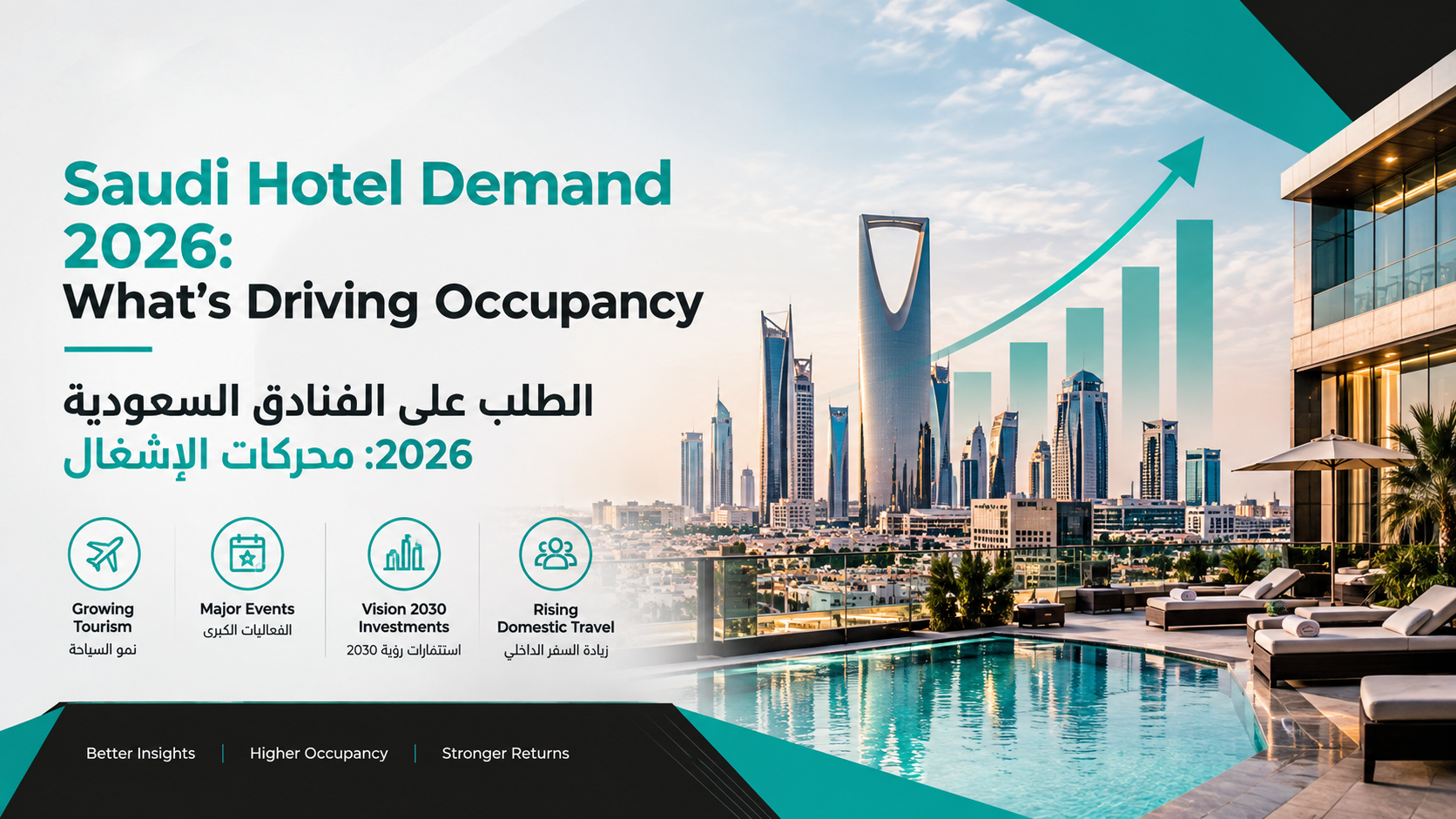
Saudi hotel demand in 2026 is being driven by six forces working at the same time: the Regional Headquarters programme pulling long-stay corporate travel into Riyadh; a national events and seasons calendar that now runs almost year-round; sustained Umrah growth in Makkah and Madinah; a fast-maturing domestic leisure market; new international air capacity and easier visas; and the first real wave of Red Sea and AlUla resort demand. What makes 2026 different from previous years is that these drivers are no longer seasonal spikes — they are overlapping, which is changing how occupancy behaves week to week in every major city.
Ask ten hoteliers in the Kingdom what is happening to hotel occupancy in Saudi Arabia right now and you will get ten different answers — because they are looking at different cities, different segments and different weeks. Riyadh is not Jeddah. Jeddah is not Makkah. And a Thursday in AlUla during a cultural season has almost nothing in common with a Tuesday in Al Khobar.
That fragmentation is the single most important thing to understand about Saudi hotel demand in 2026. The Kingdom is no longer one hospitality market with a religious peak and a quiet summer. It is now at least seven distinct demand systems, each with its own calendar, its own guest profile and its own risks. Operators who still plan with a single national forecast are consistently getting their staffing, pricing and inventory wrong.
This article breaks down what is actually driving hotel performance in Saudi Arabia this year: the real demand engines, how each major city behaves, where new supply is putting pressure on rate, and what Vision 2030 milestones mean for the rest of the decade. It is written for owners, asset managers, general managers and investors who need to make decisions — not headlines.
Before looking at cities, it helps to be precise. Hotel performance is usually discussed through three numbers, and they tell you very different things. Confusing them is how owners end up celebrating a strong occupancy figure that is quietly destroying their profit.
| Metric | What it measures | What it hides |
|---|---|---|
| Occupancy | Percentage of available rooms sold | Whether you discounted heavily to fill them |
| ADR | Average daily rate achieved per room sold | How many rooms sat empty at that rate |
| RevPAR | Revenue per available room (occupancy × ADR) | Your cost of servicing that revenue |
| GOPPAR | Gross operating profit per available room | Very little — it is the honest number |
In a market expanding as quickly as Saudi Arabia's, this distinction matters more than usual. High occupancy achieved through discounting, in a city absorbing thousands of new keys, is not a success story — it is a warning. The right question in 2026 is not "are we full?" but "are we full, at a healthy rate, at a cost we control?"
Saudi Arabia's policy requiring companies that want major government contracts to base their regional headquarters in the Kingdom has changed Riyadh's demand profile in a way no marketing campaign could. Corporate relocation generates a distinctive and very valuable pattern: extended-stay demand while executives search for housing and schools, repeated short visits from headquarters teams, project-based consultant travel lasting weeks, and a steady drip of vendor and partner visits once the office is open.
This is mid-week, rate-resilient, high-repeat business. It is also the reason serviced apartments and extended-stay formats have become one of the strongest asset classes in the capital.
Riyadh Season, Jeddah Season, Soudah Season, the Diriyah calendar, AlUla's winter programming, major sporting fixtures, cultural festivals and an expanding roster of international conferences and exhibitions. Individually, each creates a spike. Collectively, they have filled in what used to be the Kingdom's dead weeks. The practical effect is that Saudi hotels now face fewer deep troughs — but also fewer genuinely quiet periods in which to renovate, retrain or catch their breath.
Under the Pilgrim Experience Programme, the Kingdom has targeted 30 million Umrah pilgrims annually by 2030. Every step toward that target — easier visa routes, longer permitted stays, bundled tourist-and-Umrah itineraries, expanded airport and rail capacity — converts directly into room nights in Makkah and Madinah, and increasingly into leisure nights in Jeddah, Taif and beyond. The strategic shift worth noting is that pilgrims are no longer treated as single-purpose visitors. A pilgrim who extends the trip to see AlUla or the Red Sea coast is now an explicit policy goal, and it redistributes demand across the map.
Saudi families historically spent their leisure budgets abroad. A large share of that spend now stays inside the Kingdom — driven by new attractions, better hotel stock outside the big three cities, improved road and air links, and a cultural shift in how domestic travel is perceived. Domestic leisure behaves differently from corporate demand: it is weekend-weighted, holiday-clustered, highly price-sensitive, booked late, and it demands family rooms, connecting rooms and serious F&B. Properties designed purely for business travellers often capture it badly.
Demand cannot exist without a way to arrive. The tourist eVisa, stopover visas, expanded routes at Riyadh and Jeddah, and the build-out of new airport capacity have removed friction that used to cap international leisure arrivals entirely. Air seat capacity is the ceiling on international demand in any market — when it rises, hotel demand follows with a short lag, and when a route is cut, the effect on a destination like AlUla or Tabuk is immediate and severe.
NEOM, Red Sea Global, AMAALA, Qiddiya, Diriyah and New Murabba generate demand twice. First as construction and project demand: engineers, contractors, consultants and inspection teams needing accommodation, catering and facilities support, often in locations with no existing hospitality infrastructure. Then, later, as guest demand once the destinations open. In 2026 most of these projects are still generating the first kind — which is why workforce hospitality and remote-site operations are among the fastest-growing segments in the Kingdom.
Highlight — the overlap effect
The defining feature of 2026 is not that any single driver is strong. It is that they now overlap. A Riyadh hotel can face a conference, a season weekend, a corporate relocation block and a domestic family surge in the same seven days. Forecasting models built on last year's monthly averages will miss this completely — and staffing built on those models will fail on exactly the nights that matter most.
The capital has the most diversified demand base in the Kingdom and the most aggressive new supply pipeline. Its core remains government, corporate and MICE travel, concentrated Sunday to Wednesday. What is new is the weekend: Riyadh Season, Diriyah, Boulevard City and a growing dining scene have created genuine leisure occupancy on nights that used to be soft. The risk in Riyadh is not demand — it is absorption. With thousands of keys arriving ahead of Expo 2030, the question is whether demand growth keeps pace with supply growth, and whether it does so without eroding rate.
Jeddah simultaneously serves as the gateway for Umrah and Hajj arrivals, a commercial hub, a Red Sea leisure destination, a domestic summer escape and an events host. Few cities anywhere juggle this many guest types in one market. That diversity is a strength — when one segment softens, another usually compensates — but it makes revenue management genuinely difficult, because the same hotel may need three different pricing and service approaches within one month.
Makkah operates on a logic found nowhere else. Demand is enormous, deeply seasonal around Ramadan and Hajj, and driven by religious observance rather than discretionary choice. Length of stay is long. Group and operator business dominates. Proximity to the Haram is the single largest determinant of rate. And the operational challenge is extraordinary: extreme density, guests of every nationality and age, round-the-clock food service, and a duty of care that carries spiritual weight. The margin for error here is the smallest in the industry.
Madinah's demand curve is less extreme than Makkah's and more evenly spread, largely because most pilgrims combine the two cities in one itinerary. Improved connectivity and expanded air access mean Madinah increasingly captures arrivals directly rather than as an afterthought, which supports both occupancy and length of stay.
The Eastern Province runs on energy, petrochemicals, industrial projects and a steady flow of corporate travel — reliable, mid-week, rate-stable demand. Layered on top is weekend leisure traffic from within the Kingdom and across the causeway from Bahrain. It is a market where occupancy is rarely spectacular but rarely collapses, which makes it attractive to owners who value predictability over peaks.
AlUla has the highest demand volatility of any established Saudi destination. It performs strongly during the cooler months and its cultural programming, and thins out sharply outside those windows. Its occupancy is tightly coupled to event calendars and flight schedules — which means it rewards operators who can flex their cost base up and down rather than carry a fixed team year-round.
While most of the Kingdom heats up, the southwest highlands cool down. Abha, Soudah and the Asir region capture a large domestic leisure flow in summer and around Eid, with family groups, longer stays and heavy demand for connecting rooms and casual dining. Continued investment in Soudah Peaks points toward a longer season and a higher-end segment over time.
This is the only part of the Saudi market where the hotels arrived before the demand. Phased resort openings along the Red Sea are building an international leisure market essentially from zero, and performance here depends almost entirely on international air access and how quickly the destination establishes itself against established competitors in the Indian Ocean and Mediterranean. Early-stage resort destinations typically take several years to stabilise — this is normal, not a failure signal.
A side-by-side view of how each market actually behaves.
| Market | Primary demand engine | Peak periods | Typical stay | Biggest 2026 swing factor |
|---|---|---|---|---|
| Riyadh | Corporate, government, MICE, RHQ relocation | Autumn & spring; season weekends | 2–4 nights | New supply absorption vs. demand growth |
| Jeddah | Mixed: pilgrimage gateway, corporate, leisure | Ramadan, summer, event season | 2–5 nights | Umrah extension travel & coastal spillover |
| Makkah | Umrah and Hajj | Ramadan, Hajj, school holidays | 4–10 nights | Visa policy and pilgrim capacity expansion |
| Madinah | Pilgrimage, usually paired with Makkah | Ramadan and Hajj shoulder | 3–5 nights | Direct international flight capacity |
| Dammam / Khobar | Industrial and corporate travel | Weekends; Q1 and Q4 | 1–3 nights | Project activity and GCC weekend flow |
| AlUla | Cultural and experiential leisure | Cooler months, event programming | 2–3 nights | Event calendar and air access |
| Abha / Asir | Domestic family leisure | Summer and Eid holidays | 3–5 nights | Domestic travel sentiment; Soudah build-out |
| Red Sea / Tabuk | International and premium domestic resort leisure | Autumn through spring | 4–7 nights | Phased openings and international air routes |
Most coverage of the Saudi hotel market focuses only on demand. That is half the equation. The Kingdom has one of the largest hotel development pipelines in the world, and new keys are arriving fastest in exactly the cities where demand is strongest.
This produces a predictable pattern seen in every fast-growing market: occupancy holds up because demand is genuinely rising, but rate comes under pressure as new properties discount to build a base. Owners who benchmark themselves only on occupancy can look healthy for two or three years while their RevPAR and margin quietly erode.
Note — three questions worth asking about your own asset
"In a rising market, anyone can fill rooms. The operators who will still be profitable in 2030 are the ones who learned to fill them at the right rate, with the right cost base, using teams that stay long enough to get good at it."
Demand is a market condition. Capturing it profitably is an operating capability. These are the practices that separate properties that convert this cycle into profit from those that simply ride it.
Tip — the compression-night test
Pull your ten highest-occupancy nights from the last six months. Now check your guest satisfaction scores and complaint volume on those exact nights. If quality dropped when demand peaked, you do not have a demand problem — you have a capacity and staffing problem, and it is costing you the repeat business that those high-demand nights were supposed to generate.
Saudi Arabia has set a target of 150 million annual visits by 2030, with tourism contributing around 10% of GDP. Between now and then, the demand calendar has several fixed points that every owner should already be planning around.
A multi-city football tournament creates intense, geographically distributed demand for several weeks, with a large share of group and media business. It is also the Kingdom's first full-scale rehearsal for mega-event hospitality logistics.
World Expos generate sustained demand over months rather than days, and they pull an unusual mix: delegations, exhibitors, media, business visitors and leisure tourists simultaneously. Riyadh's current supply wave is being built for this moment — which makes the years immediately before it the tightest period for rate.
The largest hospitality event in the world, spread across multiple host cities, with demand concentrated in short, extreme windows. Its real significance is what it leaves behind: infrastructure, trained workforce and global visibility that continue generating demand long after the final whistle.
Beyond the headline events: continued Umrah capacity expansion reshaping the pilgrimage calendar; a maturing domestic leisure market that will become more demanding and less price-driven; sustainability moving from marketing claim to procurement requirement under the Saudi Green Initiative and the Mostadam rating system; AI-assisted demand forecasting becoming standard rather than differentiating; and — most importantly — trained hospitality talent becoming the single hardest resource to secure in the Kingdom.
Highlight — the real constraint is not rooms
Saudi Arabia will have enough hotel rooms by 2030. What is far less certain is whether it will have enough experienced general managers, revenue managers, executive chefs and front-office supervisors to run them properly. Demand can be created by policy and marketing. Capability has to be built year by year — which is why training infrastructure and staff retention are now competitive strategy, not HR housekeeping.
Direct answers to the questions most often asked about Saudi hotel demand and occupancy in 2026.
Six overlapping drivers: corporate relocation under the Regional Headquarters programme, a near-continuous events and seasons calendar, sustained Umrah and Hajj growth, a maturing domestic leisure market, expanded air capacity and easier visas, and demand generated by giga-project construction and early resort openings.
It depends entirely on the period. Makkah reaches the highest peaks during Ramadan and Hajj, but has deeper troughs between them. Riyadh has the most consistent year-round occupancy because its demand base is the most diversified. Because rankings shift month to month, always check a current source such as STR or Ministry of Tourism reporting rather than relying on a general claim.
It is a risk to rate rather than to occupancy. Demand growth in the Kingdom is real and structural, so rooms are generally being filled. But in cities absorbing large volumes of new keys, newly opened properties often discount to build a customer base, which pulls average rates down across the competitive set. Owners should monitor RevPAR and GOPPAR, not occupancy alone.
In Riyadh, mid-week is busiest with corporate travel, so weekends outside major season events are usually better value — though season weekends and conference weeks can be extremely tight. In Jeddah, avoid Ramadan and the peak summer weeks if price is the priority. For both cities, booking well ahead of any announced major event is essential.
Significantly, and increasingly by design. Longer permitted stays and combined tourist-and-pilgrimage itineraries mean many visitors now extend their trip to Jeddah, Taif, AlUla or the Red Sea coast. This distributes pilgrimage-linked demand across a much wider set of cities than in previous years.
Vision 2030 made tourism a core pillar of economic diversification, targeting 150 million annual visits by 2030 and roughly 10% of GDP from tourism. In practice this has created new destinations, a national events calendar, expanded Umrah capacity, far easier visa access, and a very large hotel development pipeline — shifting Saudi Arabia from a predominantly religious and business travel market to a genuinely mixed one.
Segment diversification, day-level forecasting, a flexible labour model, F&B that attracts local residents, staff retention, and consolidated operational accountability. Rising demand covers a lot of weaknesses in the short term; operating discipline is what converts it into durable profit.
Primary sources include STR/CoStar market reports, the Saudi Ministry of Tourism and Saudi Tourism Authority, the Tourism Development Fund, and published market reviews from major hotel advisory firms. Treat any occupancy or ADR figure without a named source and reporting period as unusable for decision-making.
Saudi hotel demand in 2026 is strong, but it is not uniform, and it is not automatic. Riyadh is absorbing a corporate relocation wave while building for Expo 2030. Jeddah is balancing more guest types than almost any city in the world. Makkah and Madinah are scaling the most demanding hospitality operation on earth. AlUla, Asir and the Red Sea coast are building new demand from very different starting points. One national headline number describes none of them accurately.
The common thread is that demand is arriving faster than operational capability is being built. Rooms can be constructed in two years; a general manager who can run one profitably takes ten. That gap — not a shortage of guests — is the real constraint on Saudi hospitality performance between now and 2034.
For owners and asset managers, the practical conclusion is straightforward. Stop benchmarking on occupancy alone. Forecast by segment and by day. Build a cost base that flexes with a volatile calendar. And treat the people who deliver the experience as the asset that actually determines your returns — because in the Saudi market of 2026, demand is the easy part.
Turn rising demand into actual profit
Dyafa builds and operates hospitality across the Kingdom — hotels, venues, events, food and beverage, workforce sites and facilities support. One accountable partner, one standard, one reporting line. Tell us about your property or project and we will show you where the margin is hiding.
Tags
Saudi hotel demand 2026, hotel occupancy in Saudi Arabia, Riyadh hotel market, Jeddah hotel occupancy, Makkah hotel demand, Madinah hotels, Saudi hospitality industry 2026, hotel performance Saudi Arabia, RevPAR Saudi Arabia, ADR Saudi hotels, Vision 2030 tourism, Saudi tourism growth, what is driving hotel occupancy in Saudi Arabia in 2026, which Saudi city has the highest hotel occupancy, how Vision 2030 is changing hotel demand in Saudi Arabia, hotel demand forecast Saudi Arabia 2026, how Umrah growth affects Makkah hotel occupancy, best time to book hotels in Riyadh, Saudi hotel supply pipeline, Regional Headquarters programme Riyadh, Expo 2030 Riyadh hotels, FIFA World Cup 2034 hospitality, AlUla hotel demand, Red Sea Global resorts, hotel management company Saudi Arabia, Dyafa



© Copyright 2024 Dyafa - All Rights Reserved | Created By Fandaqah Information Technology