
Dyafa Insights for Hotel Owners | Hotel Operations & Investment | Reading time: about 13 minutes
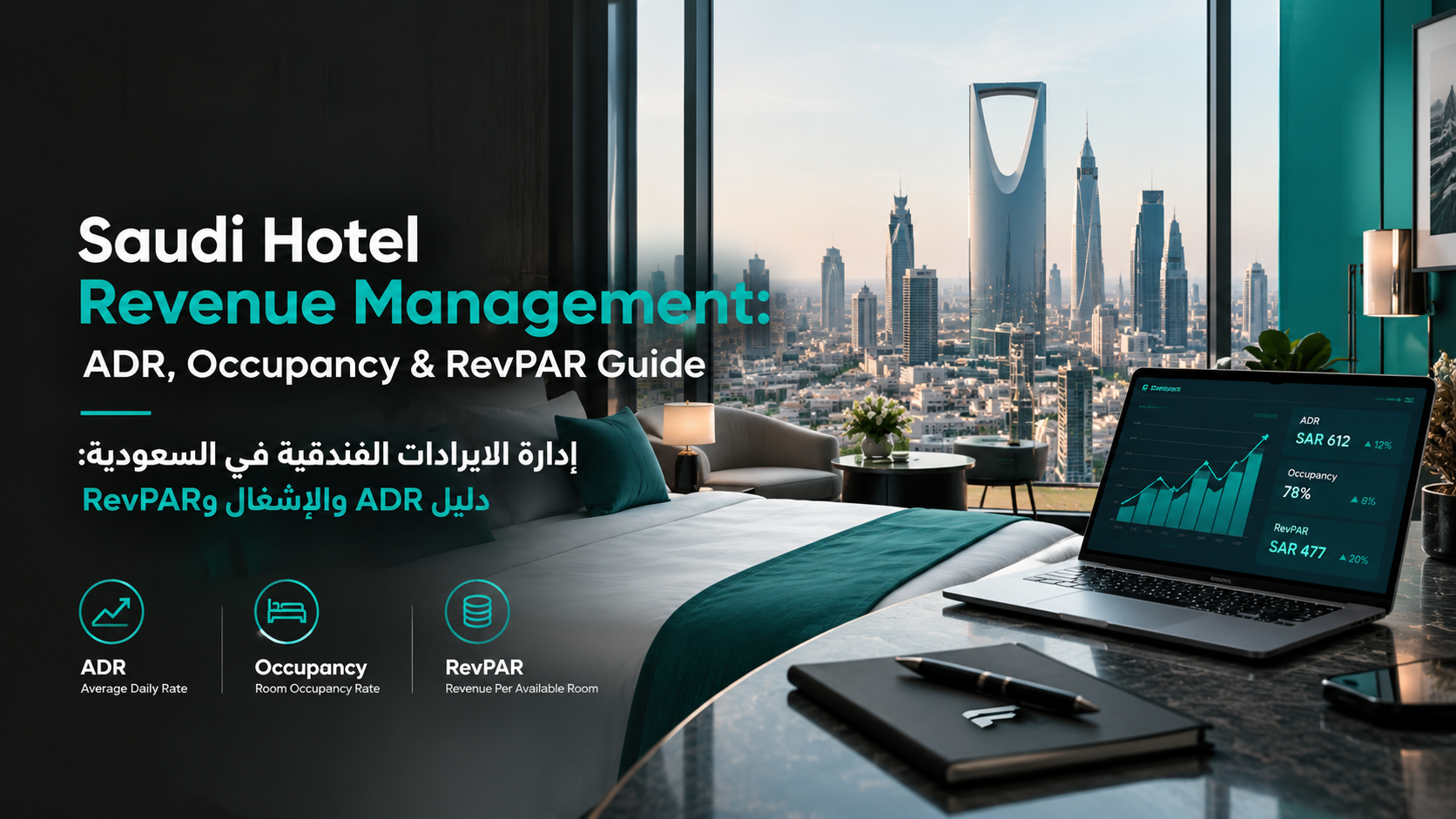
Two hotels sit on the same street in Riyadh. Both report 80% occupancy for the month. One owner is celebrating; the other is quietly worried about cash flow. How can the same occupancy tell two completely different stories? The answer lies in Saudi hotel revenue management, and specifically in three numbers every owner, investor, and general manager in the Kingdom must understand: ADR, occupancy rate, and RevPAR.
Saudi Arabia's hospitality market is changing faster than at any time in its history. New hotels are opening across Riyadh, Jeddah, the Eastern Province, and giga-project destinations. International brands and Saudi operators compete for the same guests. Demand swings sharply around Ramadan, Hajj, major events, and school holidays. In this environment, filling rooms is not enough. You need to fill them at the right price, through the right channel, at the right time.
This guide explains the core hotel KPIs in Saudi Arabia in simple terms, with worked examples in Saudi riyals, real market scenarios, a strategy comparison that shows why the highest occupancy is not always the best result, and a look at how Vision 2030 is reshaping hotel pricing. It is written by Dyafa Hotels & Resorts, a Saudi hospitality group that works with hotel owners on day-to-day operations and performance.
Quick Answer: What are ADR, Occupancy, and RevPAR?ADR (Average Daily Rate) is room revenue divided by rooms sold, showing the average price you achieved. Occupancy is rooms sold divided by rooms available, showing how full the hotel was. RevPAR (Revenue per Available Room) is room revenue divided by rooms available, or ADR multiplied by occupancy. RevPAR is the most useful single measure of room performance because it combines price and volume.
Hotel revenue management is the discipline of selling the right room, to the right guest, at the right price, through the right channel, at the right time. A hotel room is a perishable product: if a room stays empty tonight, that night's revenue is lost forever. You cannot store it and sell it tomorrow. This simple fact is what makes revenue management so important.
In practice, hotel revenue management in Saudi Arabia means forecasting demand, setting and adjusting room rates, controlling length-of-stay and booking restrictions, managing distribution across booking platforms, corporate accounts, travel agents, and your own website, and measuring the results with a small set of reliable KPIs. The three KPIs at the heart of this work are ADR, occupancy, and RevPAR.
Global revenue management principles apply everywhere, but the Saudi market has characteristics that change how they are used. Religious tourism in Makkah and Madinah creates some of the most concentrated demand peaks in the world. The Friday–Saturday weekend shifts leisure patterns compared with many international markets. Business demand in Riyadh and the Eastern Province rises and falls with conferences, government activity, and project cycles. Large entertainment and sports events can fill a city within days of being announced. And rapid new supply means competitive sets are constantly changing.
The easiest way to understand these metrics is to calculate them. Let us use an illustrative 120-room hotel over a 30-day month.
Formula: Occupancy = Rooms Sold ÷ Rooms Available × 100
Example: 2,520 ÷ 3,600 = 70% occupancy. Occupancy tells you about volume and demand capture, but it says nothing about price. A hotel can reach 95% occupancy simply by selling rooms too cheaply.
Formula: ADR = Room Revenue ÷ Rooms Sold
Example: SAR 1,008,000 ÷ 2,520 = SAR 400 ADR. ADR reflects pricing power and guest mix, but it ignores empty rooms. A hotel with a very high ADR and half its rooms empty may be underperforming.
Formula: RevPAR = Room Revenue ÷ Rooms Available, or ADR × Occupancy
Example: SAR 1,008,000 ÷ 3,600 = SAR 280 RevPAR. Check: SAR 400 × 70% = SAR 280. RevPAR combines price and volume into one figure, which is why it is the most widely used measure for comparing hotel room performance over time and against competitors.
💡 Owner's Tip: Always confirm how your reports treat VAT, service charges, complimentary rooms, and breakfast included in the rate. Calculating ADR on gross amounts one month and net amounts the next makes trends meaningless. Agree one definition and apply it consistently.
RevPAR is powerful, but it only measures room revenue. Owners and investors ultimately care about profit and total income. These additional hotel performance metrics complete the picture.
| KPI | Formula | What It Tells You | Blind Spot |
|---|---|---|---|
| Occupancy | Rooms Sold ÷ Rooms Available | Demand capture and volume | Ignores price |
| ADR | Room Revenue ÷ Rooms Sold | Pricing power and guest mix | Ignores empty rooms |
| RevPAR | Room Revenue ÷ Rooms Available | Overall room performance | Ignores costs and non-room revenue |
| TRevPAR | Total Revenue ÷ Rooms Available | Rooms plus F&B, events, spa, parking | Ignores costs |
| GOPPAR | Gross Operating Profit ÷ Rooms Available | Operating profitability per room | Needs accurate cost reporting |
| CPOR | Rooms Department Cost ÷ Rooms Sold | Cost of servicing each occupied room | Does not show revenue side |
Your numbers only mean something when compared with the hotels your guests are actually choosing between, known as your competitive set. Three indices make this comparison simple. An index of 100 means you are exactly at fair share; above 100 means you are winning.
Example: Our 120-room hotel runs 70% occupancy at SAR 400 ADR (RevPAR SAR 280). Its comp set averages 72% at SAR 347 (RevPAR about SAR 250). The result: MPI 97, ARI 115, and RGI 112. The hotel is slightly behind on volume but well ahead on rate, and it is capturing 12% more than its fair share of revenue. The next question for the revenue team is whether a small, targeted rate adjustment could win back occupancy without giving up that advantage.
This is the most important lesson in RevPAR optimization. Let us compare three pricing strategies for the same 120-room hotel over the same 30-day month. We assume a cost per occupied room (CPOR) of SAR 90, covering housekeeping, laundry, amenities, utilities, and commissions.
| Measure | A: Rate First | B: Volume First | C: Balanced |
|---|---|---|---|
| ADR | SAR 450 | SAR 380 | SAR 420 |
| Occupancy | 60% | 78% | 72% |
| Rooms sold | 2,160 | 2,808 | 2,592 |
| RevPAR | SAR 270.0 | SAR 296.4 | SAR 302.4 |
| Room revenue | SAR 972,000 | SAR 1,067,040 | SAR 1,088,640 |
| Room costs (SAR 90 CPOR) | SAR 194,400 | SAR 252,720 | SAR 233,280 |
| Rooms contribution | SAR 777,600 | SAR 814,320 | SAR 855,360 |
Strategy B looks impressive on the occupancy report, yet Strategy C earns SAR 41,040 more contribution in one month while selling 216 fewer room nights. That means less wear on rooms, less pressure on housekeeping, and more capacity for higher-paying last-minute guests. Over a full year, a gap of that size becomes a meaningful difference in asset value.
📌 Note: These figures are an illustrative model, not results from a specific property. Real outcomes depend on your market, competitive set, channel costs, and demand elasticity. The principle, however, holds in almost every market: optimize for RevPAR and profit, not occupancy alone.
"A full hotel is not the goal. A profitable hotel is. Every room sold carries a cost, so the question is never 'how many rooms did we sell?' but 'how much did each available room earn for the owner?'"— Dyafa Hotels & Resorts
A structured revenue management approach delivers benefits that go well beyond a better monthly report. For Saudi hotel owners, the main gains include:
There is no single playbook for hotel pricing strategy in Saudi Arabia. These typical scenarios show how the same KPIs lead to different decisions depending on location and guest mix.
Hotels near the Haram can see demand far exceed supply during the last ten nights of Ramadan and the Hajj season, while other months are much quieter. The revenue priority is to forecast these peaks early, agree allocations with Umrah and Hajj operators carefully, apply minimum-stay rules on the highest-demand nights, and avoid releasing too much inventory at low contracted rates. The off-peak challenge is equally important: building steady Umrah business across the rest of the year to lift annual RevPAR.
Riyadh business hotels typically run strong Sunday-to-Wednesday corporate demand, then soften on the weekend. Major conferences, exhibitions, and entertainment events can create sudden compression. The strategy focuses on negotiated corporate rates with the right companies, dynamic pricing around the events calendar, and weekend leisure packages to fill the Thursday-to-Saturday gap.
In the Eastern Province, weekday demand often comes from energy, industrial, and corporate travel linked to Dhahran, Dammam, and Jubail, while weekends bring leisure guests from Riyadh and travellers using the King Fahd Causeway to Bahrain. Revenue management here balances corporate contracts during the week with higher-yield leisure pricing on weekends, and uses the cooler months from October to April to maximize ADR on sea-view rooms.
Resorts in emerging destinations such as AlUla or along the Red Sea coast face a different challenge: building demand in markets with little historical data. The focus shifts to rate positioning, length-of-stay pricing, packages that combine rooms with experiences and dining, and TRevPAR, since spending outside the room can be a large share of total revenue.
A new hotel has no booking history, so its first rates are set using comp set research, market demand studies, and the owner's investment targets. Getting the pre-opening phase right, including channel setup, corporate sales, rate structure, and a realistic ramp-up plan for occupancy and ADR, shapes the hotel's performance for years. Early heavy discounting to "fill the hotel" can anchor guest expectations at a level that is hard to recover from.
⭐ The Saudi Revenue Calendar ChecklistBuild your pricing calendar around the Hijri and Gregorian dates that drive Saudi demand: Ramadan and Eid Al-Fitr, Hajj and Eid Al-Adha, Founding Day, Saudi National Day, school holidays, and your city's major events. Review it at least weekly, because event announcements can change demand quickly.
Dyafa Hotels & Resorts is a Saudi hospitality group headquartered at 2876 Prince Turki Road, Al Khobar. The group combines a dedicated hotel operations and maintenance company, a hospitality real estate arm, and its own hotel brand, Dyafa Inn. This structure means Dyafa understands hotel performance from both sides of the table: as an operator responsible for daily results, and as a partner who speaks the language of owners and investors.
For owners, the value lies in connecting revenue decisions with the full operation. Rate strategy is only as good as the service that justifies it, the maintenance that keeps rooms sellable, and the cost control that turns revenue into gross operating profit (GOP). Dyafa works with owners through hotel management agreements and operational support, bringing local market knowledge of Saudi demand patterns to every stage, from pre-opening to stabilized operation.
The Kingdom's hospitality sector is entering a new phase, and Saudi hotel revenue management will need to evolve with it. These are the trends owners should prepare for.
Vision 2030 raised its tourism ambition to 150 million annual visits by 2030 after the Kingdom reached its original target early. The tourist eVisa, launched in 2019, opened Saudi Arabia to international leisure travellers, and domestic tourism continues to grow. At the same time, a large pipeline of new hotel rooms is entering the market. More demand and more supply together mean competitive sets will shift, and hotels that manage rate and positioning actively will be better placed than those that rely on a static strategy.
Revenue management systems increasingly use machine learning to forecast demand and recommend rates, reacting to booking pace, competitor prices, and events in near real time. Technology will handle more of the calculation, but human judgment remains essential in Saudi Arabia, where religious seasons, event announcements, and group business require local understanding that data alone cannot provide.
The industry is moving from rooms-only thinking toward total revenue management, measuring every revenue stream per available room and, most importantly, profit. As Saudi hotels expand dining, events, wellness, and experiences, TRevPAR and GOPPAR will become the metrics that owners and investors watch most closely.
🚀 What This Means for Owners: Ask for monthly reporting that shows occupancy, ADR, RevPAR, TRevPAR, and GOPPAR side by side, with comp set indices. If your current reports stop at occupancy, you are only seeing part of your hotel's performance.
ADR is the average rate earned per room sold, while RevPAR is the average room revenue earned per room available. ADR ignores empty rooms; RevPAR includes them. That is why RevPAR gives a more complete picture of room performance.
Divide total room revenue by the number of rooms available for the period, or multiply ADR by occupancy. For example, a hotel with an ADR of SAR 400 and 70% occupancy has a RevPAR of SAR 280. Use room revenue net of VAT for consistent reporting.
No. High occupancy achieved through heavy discounting can reduce RevPAR and profit, because every occupied room carries costs such as housekeeping, laundry, utilities, and commissions. The goal is the best combination of rate and occupancy, measured by RevPAR and GOPPAR.
GOPPAR is gross operating profit per available room. It shows how much operating profit each room generates after departmental and undistributed operating costs, making it one of the most important metrics for owners and investors assessing a hotel's true performance.
In Makkah and Madinah, Ramadan and Hajj create very high demand peaks that support higher rates and minimum-stay rules. In other cities, Ramadan can change daily travel patterns and dining demand, so hotels often adjust pricing, packages, and F&B offers such as iftar and suhoor.
An RGI of 100 means your hotel earns exactly its fair share of RevPAR compared with its competitive set. Above 100 means you are outperforming competitors; below 100 means you are losing share and should review your rate, distribution, or positioning.
Most well-managed hotels review rates daily for the coming weeks and hold a weekly revenue meeting to review forecasts, booking pace, and the events calendar. During peak seasons or major events, reviews may happen several times a day.
Many owners choose a hotel management company because revenue results depend on the whole operation: pricing, sales, distribution, service, maintenance, and cost control. A management partner with Saudi market experience can connect these areas and report performance clearly against owner targets.
Effective Saudi hotel revenue management starts with three numbers. Occupancy tells you how full you were. ADR tells you what price you achieved. RevPAR brings them together to show how well every available room performed. Add TRevPAR, GOPPAR, and competitive indices, and you have a clear, honest view of whether your hotel is truly winning in its market.
As Vision 2030 brings more visitors, more events, and more competition to the Kingdom, the hotels that thrive will be those that price with discipline, understand Saudi demand patterns deeply, and focus on profit per available room rather than occupancy alone. The opportunity is significant, and the owners who act on these metrics today will be the best positioned for the decade ahead.
Want Stronger RevPAR and GOP From Your Hotel?Talk to Dyafa Hotels & Resorts about hotel management, operations, and revenue performance built for the Saudi market. Call 9200 6655 | Email [email protected] |
Tags: Saudi hotel revenue management, hotel revenue management Saudi Arabia, ADR, average daily rate, hotel occupancy rate, RevPAR, RevPAR explained, how to calculate RevPAR, how to increase RevPAR in Saudi Arabia, GOPPAR, TRevPAR, hotel KPIs Saudi Arabia, hotel performance metrics, RevPAR index RGI, hotel pricing strategy Saudi Arabia, Ramadan and Hajj hotel pricing, hotel management company Saudi Arabia, pre-opening hotel strategy, Vision 2030 hospitality, Dyafa Hotels and Resorts




© Copyright 2024 Dyafa - All Rights Reserved | Created By Fandaqah Information Technology